BLOG: Caring at a Distance – Psychosocial Support for Refugee Children in Greece
In March 2020, when the COVID-19 pandemic led to a strict lockdown in Greece, playful and in-person interactions suddenly came to a halt at the Baytna program - an early childhood program developed by Refugee Trauma Initiative (RTI) for refugee children and their caregivers. To continue to support vulnerable families emotionally and socially, RTI and its network of partners created a range of multimedia and psychosocial resources, available online in several languages, for Baytna families and beyond.
Children growing up in conflict zones, experiencing displacement, or amid multiple deprivations are at risk of trauma and toxic stress which can interrupt healthy development. In such settings children are less likely to receive the protection, safety, and nurturing care and stimulation they need to meet their developmental milestones.
In Greece, there are 120,000 displaced individuals, including children and their families, many of whom are living with the effects of trauma alongside on-going stress, uncertainty, and adversity. For the past four years, Refugee Trauma Initiative (RTI) has been delivering Baytna - a trauma and identity-informed early childhood development program specially designed for refugee children and their caregivers living in Greece, with a focus on psychosocial support. Baytna program is funded by Help Refugees and Open Society Foundations.
In designing Baytna (which means ‘home’ in Arabic), we followed what the science tells about the power of creative expression, play, and relationships for healthy development and healing from adversity. It relies on in-person interactions between facilitators, children, caregivers and trauma- and identity-informed learning environments that are created.
Since mid-2019, we scaled up Baytna through a network of local organisations who we train and provide ongoing mentoring as part of a year-long capacity building program. As of early 2020, Baytna was running at five sites across Greece: two in Athens, and three in North Greece - Thessaloniki, Polikastro and Katerini.
Supporting displaced families amidst COVID-19
In March 2020, when the COVID-19 pandemic spread worldwide and Greek authorities began a strict lockdown, thousands of displaced families were suddenly forced to stay at their residence, and the usual nurturing interactions at Baytna became impossible as centres had to close.
It was important to continue supporting the families who attended Baytna so that they felt emotionally and socially supported - receiving care, feeling connected with a community, and having Baytna-inspired activities to do. In addition, consultations with people from displaced communities revealed the need for remote and innovative psychosocial support.
Online psychosocial support for families
Responding to the needs of displaced people, we developed psychosocial activity ideas for parents and their children - a taste of Baytna at home - which required either no materials or simple household items. The activity ideas for children from different ages were translated into various languages, both written and audio recordings, and shared with the families via the local partners (e.g. by text messages or phone calls).
We, together with our partners, co-created interactive resources and videos for families, leveraging different strengths and the combined collaborative power of the Baytna network. These resources have been shared across social media and are available on RTI’s website.
Some examples include:
- Movement with Marianna, RTI
- Storytelling with Vaseilia (Athen’s Comic Library), Fatima (OCC) and Vasiliki, RTI
- Music and singalongs with Sofia and Miltos, Perichoresis
- Relaxation with Marianna, Elix
Simultaneously, we worked with partners to deliver activity care kits to families. These contained arts, craft, storytelling, and hygiene materials, as well as simple toys and posters. These were another sign of solidarity and continuity of Baytna program to families.
At times, caregivers reached out to Baytna facilitators to share their enthusiasm and gratitude for the activity ideas and videos, and to ask for advice about how to use them. Elix – a partner in Eleonas refugee camp in Athens - shared that caregivers asked how to modify the activities and also that some children recognised the activities from Baytna sessions and would teach their parents to do the same with excitement. Another Baytna partner - Athen's Comic Library - received videos from families of them trying out the activities at home, sometimes with their own unique approach.
It was very encouraging to see the Baytna activities and resources being shaped and adapted, as they were intended as inspiration to spark imagination, play, and bonding between children and their caregivers.
New era of programming
As Greece began lifting its lockdown from May 2020, the Baytna network has started to launch in-person programming again. The online resources will continue to be shared and created digitally. RTI colleagues share that it has been a joy to allow children who had already been attending Baytna to reconnect with their facilitators, if only by video, and to continue programming at a distance. It is even a greater joy to welcome children who live in other parts of Greece or in the other countries to access Baytna activities for the first time – and website statistics demonstrate the wide reach of the resources so far.
The Baytna network now has a growing bank of psychosocial resources and multimedia which are already being brought into their sessions. These can be used for any future lockdown situations, and to support RTI when training new Baytna partners. The recent collaborations have also strengthened the network and the connections between Baytna partners, fostering collaboration, sharing of ideas and development of language resources.
The COVID-19 crisis has reminded us of the power of a network, with shared values and vision, in responding with agility to changing needs of the communities we work with. Together, we can help to ensure that displaced children across Greece receive nurturing and quality care, and flourishing futures, amidst challenging and changing circumstances.
Written by Evelyn Wilcox, Head of Knowledge Management, Refugee Trauma Initiative, in collaboration with RTI team
Pictures:
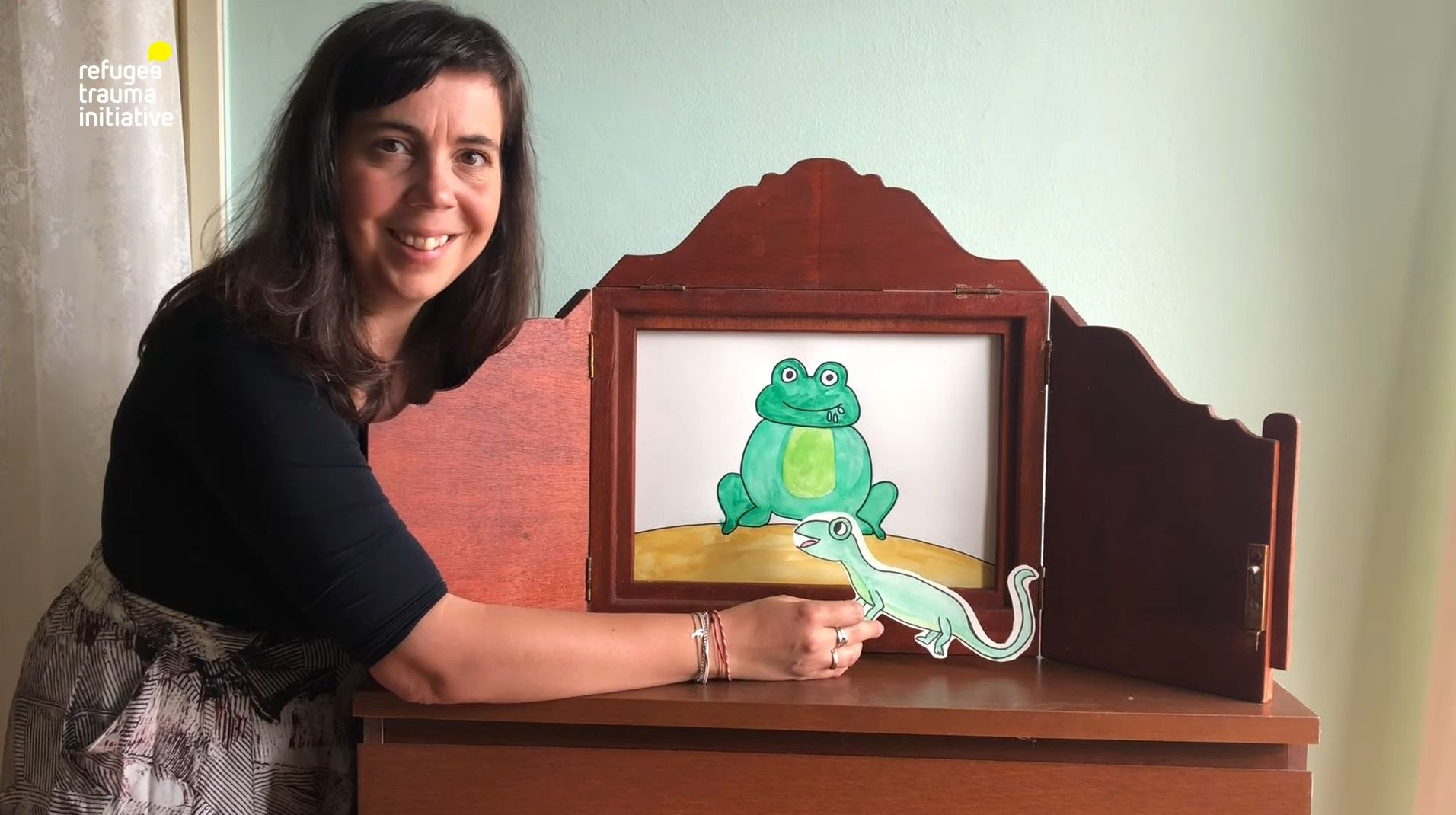
1. Vasileia, a Storyteller and Baytna Facilitator at Athen's Comic Library, as she created a Baytna video
2. Activity sets sent to families during the COVID-19 lockdown.
Read more
Engaging Men in Nurturing Care A Roadmap for Systemic Change
The Engaging Men in Nurturing Care: A Roadmap for Systemic Change provides a practical, evidence-informed framework for strengthening men’s and fathers’ involvement in early childhood care and development. Developed through the EMiNC initiative, the Roadmap responds to persistent gender inequalities in caregiving, where structural barriers—such as limited leave policies, workplace norms, and service design—continue to limit fathers’ participation. It highlights the critical role of engaged fatherhood in improving child development outcomes, supporting family well-being, and advancing gender equality across societies.
Grounded in a multi-level, systems-based approach, the Roadmap outlines how change can be driven simultaneously across policies, services, workplaces, communities, and public narratives. It offers actionable guidance for policymakers, practitioners, training institutions, and civil society actors to transform professional practices, engage fathers directly, adapt parenting programmes, and influence workplace and policy environments. Drawing on tested interventions from across Europe, it combines research, practical tools, and real-world examples to support context-specific adaptation and scaling.
Ultimately, the Roadmap positions father engagement not as a standalone issue, but as a key lever for systemic change. By promoting shared caregiving, challenging gender norms, and building strong cross-sector partnerships, it contributes to more inclusive, responsive early childhood systems. It calls for coordinated action across sectors to create the enabling conditions in which all caregivers can participate fully—ensuring better outcomes for children, families, and society as a whole.
Published in:
2026
Organization(s):
International Step by Step Association,
Language:
Soft Skills Toolbox
This Handbook is part of the Soft Skills Toolbox, a resource developed within the Erasmus+ project Soft Skills for High Quality Education (KA220-SCH-966C750C). The project brings together national leading organisations and partner kindergartens from Slovenia, Croatia, Slovakia, and Estonia, united by a shared commitment: to strengthen the quality of early childhood education and care (ECEC) through the professional development of those who lead it from within.
The Toolbox was created for you — leaders of Teacher Support Learning Groups (TSLGs). Whether you are a preschool teacher who facilitates a professional learning community in your kindergarten, a coordinator supporting colleagues in reflective practice, or a principal fostering a culture of continuous learning, this resource is designed to support your growth.
This Handbook serves two purposes. First, it provides the conceptual and theoretical foundation that underpins the Toolbox: how adults learn, why soft skills matter for professional learning, how learning communities can be effectively facilitated, and how trust and psychological safety enable meaningful professional dialogue. Second, it offers practical guidance on how to navigate and use the other components of the Toolbox — the videos, the reflective cards, the collection of practical activities and techniques, and the tips & tricks.
You do not need to read this Handbook from beginning to end before using the Toolbox. Think of it as a companion you can return to. Some readers will find it most useful before a new series of TSLG meetings; others will come back to specific sections when a particular challenge arises. Both approaches are valid. The handbook connects theory and practice and helps users understand not only what to do, but why these approaches matter.
Authors: Jerneja Jager, Mateja Režek, Educational Research Institute, Slovenia; Katarína Pániková, Erika Szabóová, Miroslav Sklenka, Wide Open School n.o./Škola Dokorán, Slovakia; Liivi Türbsal, Gerda Sillaste, Hea Algus, Estonia; Bojana Gotlin, Marina Matešić, Open Academy Step by Step, Croatia; Janja Zupančič
Published in:
2026
Language:
Supporting families for nurturing care: Training resource package for home visiting practices
This training package equips trainers of home visiting professionals with essential knowledge, skills, and tools to deliver consistent, high-quality pre-service and in-service training.
Developed by UNICEF ECARO and the International Step by Step Association (ISSA), it builds on almost ten years of collaboration and earlier home visiting modules (2017–2025). The goal is to strengthen home visiting as a key community health service supporting families from pregnancy to early childhood.
The package includes three guides: General Overview, Foundational Training, and Extended Training, each offering adaptable materials such as session plans, slides, and handouts based on nurturing and family-centered care.
It combines two main areas: (1) programmatic knowledge on child development, health, nutrition, and parental wellbeing, and (2) practical skills such as communication, relationship building, observation, problem-solving, and cultural responsiveness.
Grounded in adult learning principles, the training encourages reflection, peer learning, and practical application, fostering the professional growth of trainers and home visitors while improving the quality of home visiting services.
Trainer Guide: General Overview
Trainer Guide: Foundational Training
Day 1 PPT | PDF
Day 2 PPT | PDF
Day 3 PPT | PDF
Day 4 PPT | PDF
Day 5 PPT | PDF
Trainer Guide: Extended Training
Day 1 PPT | PDF
Day 2 PPT | PDF
Day 3 PPT | PDF
Published in:
2025
Organization(s):
ISSA, UNICEF ECARO
Language:
Contact:
Ayca Alayli, aalayli@issa.nl