ISSA’s Professional Development Opportunities Boost Kosova Education Center’s Shift to an Advocacy Organization

Based on an interview with Hana Zylfiu-Haziri, Program Manager Kosovo Education Center
As a membership organization, ISSA unites and supports professionals to deliver responsive, high-quality, and equitable services to all children and their families. For its broad diverse base of members, it offers a wide variety of opportunities to co-create and share knowledge and professional development and networking events. This blog presents how, as a result of a professional development opportunity offered under ISSA’s initiative REYN, the Kosova Education Center has made a programmatic shift by including advocacy in their work, vision and mission.
The Kosova Education Center (KEC)
KEC is a non-governmental organization funded in 2000 with the idea of focusing on provision of in-service teaching training programs. But lately Kosova Education Center has grown and now the organization focuses on 4 pillars: quality education; human rights; networking and participation in policy making; and educational research in general. KEC has also its own primary, secondary and gymnasium schools, and currently runs different projects and programs employing 30 people. Among many initiatives, KEC is working on the one that we shed light on in this blog - KRAEEYN - Kosovo Roma, Ashkali, and Egyptian Early Years Network through which KEC supports equitable access to education for Roma, Ashkali and Egyptian children, which still live in a vicious circle of poverty and social exclusion. On how KEC managed to integrate the advocacy component into its work we will learn from Hana Zylfiu-Haziri, a Program Manager at Kosovo Education Center.
How a professional development on advocacy led to an organizational shift?
According to Hana, initially KRAEEYN supported professionals and paraprofessionals in a grassroot level, as well as small organizations that supported Roma, Ashkali, and Egyptian children at the local level. Then, KRAEEYN participated in a professional development opportunity, organized by ISSA, with a focus on advocacy. It consisted of two trainings held in Sofia and Zagreb, respectively.
Back in Pristina after the trainings and sharing of the knowledge gained among KRAEEYN members, the network decided to shift its mission by integrating the component of advocacy in their existing mechanisms. Nowadays KRAEEYN is better positioned and engaged in advocacy actions at local, regional, and national levels to reach institutions and key stakeholder and decision-makers to influence the policy change at national level. KRAEEYN remains as a strong voice advocating for professionals and paraprofessionals working in the field making sure their needs are reflected in local and national action plans.
Although the topic of advocacy was familiar to her, Hana used to consider it as a big activity in which you have to gather people, and to do, and to plan. However, during the training and discussion with other national REYN representatives from 10 different countries, Hana and her team realized that they were actually doing so much advocacy, without knowing it, and “it was like an opening of our minds”. And so, they just have to be conscious that they are doing it and go for it, and maybe invite other people to join the initiative.
Hana says: “And this is when actually we decided to get into it. Since we are already doing some small steps, let's try to do something much bigger which doesn't require money or planning, and where only we have to think whom to reach”. And she concludes: “So these are the things that have influenced us, everything has been influenced by advocacy and now we are shifting completely as a network, we are doing more and more on advocacy”.
“One of the aspects that I found key to learn about advocacy is something I’m trying to put in practice in my work: how important is to find the right people to be with you and to act together as one voice. Now I see that so many things I have done and maybe I didn't succeed because I did alone. Now, all the time I'm trying to have more people on board”.
Hana also stressed that such professional development activities offer many opportunities not only to learn from the trainer but also from each other, from the peers attending such trainings. Hana shares: “Such professional development opportunities offer the chance to seat with representatives from different organizations and countries, with whom you listen to and learn from. In the training in Sofia, I was there with my program colleague. On our way back home, we had five or six hours of travel ahead of us, and this was excellent opportunity for us to reflect on the training, the content as well on the inspiring examples other participants presented during the sessions. It encouraged us to plan our future activities and make some nice plans. For instance, we heard from Croatians about an advocacy campaign they had done with soccer players, and also the Bulgarian team had some nice examples. And that was a point when we said … okay, we have to do something in this direction as well. It is very good that we are supporting paraprofessionals and professionals and we should continue supporting them, but as a KRAEEYN we are a voice that can be heard, so we have to change our way of being perceived”.
Hana continues commenting on the importance of the peer learning that takes place during such opportunities: “As we talk, things are coming to my mind, and the last REYN meeting that we had in Zagreb in 2019, was really nice. Not only because it was organized by you (ISSA) and that everything was good. We had the opportunity to reflect, to share, to think together, and to work as a team. It was really valuable, especially learning from the others what they are doing, and trying to see what can we do in our network, and how can we adapt or change current actions. That meeting was really good, really good one”.
ISSA’s support and influence goes beyond the training on advocacy
During the interview Hana stressed that ISSA has provided lots of professional development opportunities to its Members, which have also benefitted KEC and have been a great opportunity for them. One of them are the Peer Learning Activities (PLA). Specifically, Hana mentioned that they had submitted twice a proposal for the Peer Learning Activities: On the first one, at national level with three other organizations from Kosovo, Hana says “we have worked on 10 preschool institutions on improving their pedagogical practice, which has led to build in community of learners within the institutions.” The second, at international level with another ISSA member in Albania, led to a huge network of institutions from both countries to meet and where the teachers from both countries had the chance to speak, talk and share. Hana adds: “We had also the conference, where we provided a booklet with activities that teachers have created in their classrooms”.
According to Hana, both projects taking place under the PLA’s built on ISSA’s Quality Resource Pack. KEC presented ISSA’s Principles of Quality Pedagogy to the Ministry, which decided to approve them as a national document.
Hana stressed: “The document is there and teachers, even though they cannot be so much present at the moment, they are still using it. They have a system of monitoring their quality and what is also good is that the Faculty of Education has included parts of the Quality Resource Pack in their syllabuses as well. So, it all started with professional development opportunities”.
Motivations to participate in the professional development opportunities
When asked what motivated KEC to participate in these professional development opportunities, Hana mentioned that they knew that they were good chances for them to learn and share, and they wanted to be active in such activities. Hana said: “In the first case, when we applied for PLA we knew that we could do something together with other organizations from the ISSA network. For example, in our work with Albanian peers, we share a common “language” when referring to our similar situation in education we know where the problems are, what is needed and how we can we support our educational system.
In advocacy, what motivated me was more like I wanted to learn more: I needed to know more about what advocacy is and what can I do with it at national level. The training helped me first of all to understand some things and then I shared with colleagues. It actually helped me to reflect about my work as well, and not only on the current project, but also in other projects where I'm involved. And now I always try to enforce the component of advocacy also in the other projects”.
Why would Hana recommend to participate in such kind of professional development opportunities?
Hana said that first of all, she would strongly recommend to herself to continue be part of these kind of professional development opportunities and she will continue as much as she can. And she continued by saying: “But why would I do it? Because for sure they will benefit as we did it. First of all, every time you learn something, you share, for instance, we had that nice opportunities from professional development activities we have developed, we had the case when we developed a project, so there are really nice opportunities for our network to learn, to share, and to be part of different activities and initiatives”.
Read more
Engaging Men in Nurturing Care A Roadmap for Systemic Change
The Engaging Men in Nurturing Care: A Roadmap for Systemic Change provides a practical, evidence-informed framework for strengthening men’s and fathers’ involvement in early childhood care and development. Developed through the EMiNC initiative, the Roadmap responds to persistent gender inequalities in caregiving, where structural barriers—such as limited leave policies, workplace norms, and service design—continue to limit fathers’ participation. It highlights the critical role of engaged fatherhood in improving child development outcomes, supporting family well-being, and advancing gender equality across societies.
Grounded in a multi-level, systems-based approach, the Roadmap outlines how change can be driven simultaneously across policies, services, workplaces, communities, and public narratives. It offers actionable guidance for policymakers, practitioners, training institutions, and civil society actors to transform professional practices, engage fathers directly, adapt parenting programmes, and influence workplace and policy environments. Drawing on tested interventions from across Europe, it combines research, practical tools, and real-world examples to support context-specific adaptation and scaling.
Ultimately, the Roadmap positions father engagement not as a standalone issue, but as a key lever for systemic change. By promoting shared caregiving, challenging gender norms, and building strong cross-sector partnerships, it contributes to more inclusive, responsive early childhood systems. It calls for coordinated action across sectors to create the enabling conditions in which all caregivers can participate fully—ensuring better outcomes for children, families, and society as a whole.
Published in:
2026
Organization(s):
International Step by Step Association,
Language:
Soft Skills Toolbox
This Handbook is part of the Soft Skills Toolbox, a resource developed within the Erasmus+ project Soft Skills for High Quality Education (KA220-SCH-966C750C). The project brings together national leading organisations and partner kindergartens from Slovenia, Croatia, Slovakia, and Estonia, united by a shared commitment: to strengthen the quality of early childhood education and care (ECEC) through the professional development of those who lead it from within.
The Toolbox was created for you — leaders of Teacher Support Learning Groups (TSLGs). Whether you are a preschool teacher who facilitates a professional learning community in your kindergarten, a coordinator supporting colleagues in reflective practice, or a principal fostering a culture of continuous learning, this resource is designed to support your growth.
This Handbook serves two purposes. First, it provides the conceptual and theoretical foundation that underpins the Toolbox: how adults learn, why soft skills matter for professional learning, how learning communities can be effectively facilitated, and how trust and psychological safety enable meaningful professional dialogue. Second, it offers practical guidance on how to navigate and use the other components of the Toolbox — the videos, the reflective cards, the collection of practical activities and techniques, and the tips & tricks.
You do not need to read this Handbook from beginning to end before using the Toolbox. Think of it as a companion you can return to. Some readers will find it most useful before a new series of TSLG meetings; others will come back to specific sections when a particular challenge arises. Both approaches are valid. The handbook connects theory and practice and helps users understand not only what to do, but why these approaches matter.
Authors: Jerneja Jager, Mateja Režek, Educational Research Institute, Slovenia; Katarína Pániková, Erika Szabóová, Miroslav Sklenka, Wide Open School n.o./Škola Dokorán, Slovakia; Liivi Türbsal, Gerda Sillaste, Hea Algus, Estonia; Bojana Gotlin, Marina Matešić, Open Academy Step by Step, Croatia; Janja Zupančič
Published in:
2026
Language:
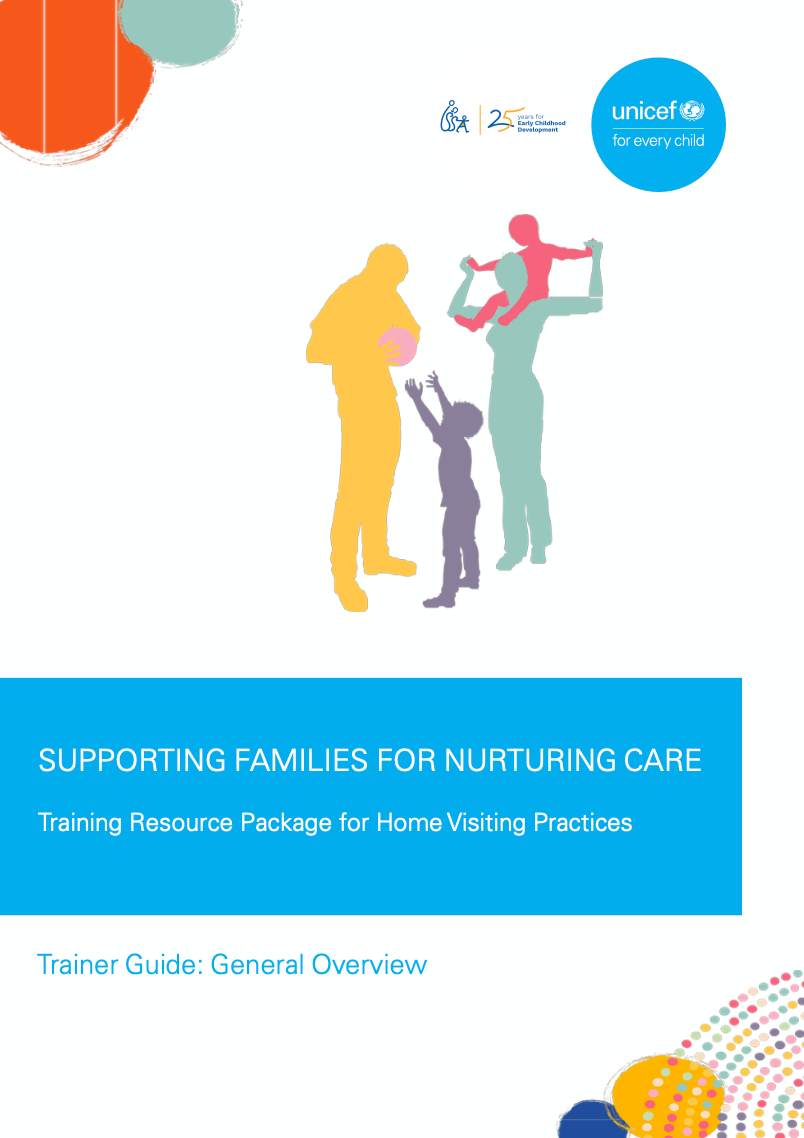
Supporting families for nurturing care: Training resource package for home visiting practices
This training package equips trainers of home visiting professionals with essential knowledge, skills, and tools to deliver consistent, high-quality pre-service and in-service training.
Developed by UNICEF ECARO and the International Step by Step Association (ISSA), it builds on almost ten years of collaboration and earlier home visiting modules (2017–2025). The goal is to strengthen home visiting as a key community health service supporting families from pregnancy to early childhood.
The package includes three guides: General Overview, Foundational Training, and Extended Training, each offering adaptable materials such as session plans, slides, and handouts based on nurturing and family-centered care.
It combines two main areas: (1) programmatic knowledge on child development, health, nutrition, and parental wellbeing, and (2) practical skills such as communication, relationship building, observation, problem-solving, and cultural responsiveness.
Grounded in adult learning principles, the training encourages reflection, peer learning, and practical application, fostering the professional growth of trainers and home visitors while improving the quality of home visiting services.
Trainer Guide: General Overview
Trainer Guide: Foundational Training
Day 1 PPT | PDF
Day 2 PPT | PDF
Day 3 PPT | PDF
Day 4 PPT | PDF
Day 5 PPT | PDF
Trainer Guide: Extended Training
Day 1 PPT | PDF
Day 2 PPT | PDF
Day 3 PPT | PDF
Published in:
2025
Organization(s):
ISSA, UNICEF ECARO
Language:
Contact:
Ayca Alayli, aalayli@issa.nl