
The SAGE Handbook of Early Childhood Policy
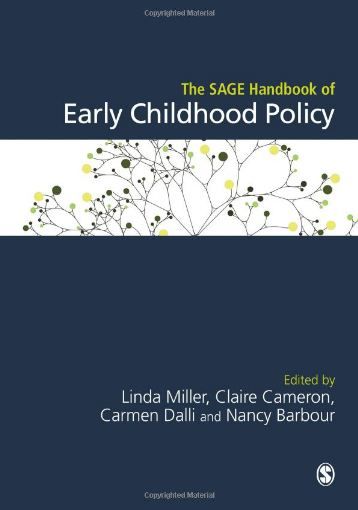
The SAGE Handbook of Early Childhood Policy draws critical attention to policy in Early Childhood Education and Care (ECEC) its relationship to service provision and its impact on the lives of children and families all around the world.
ISSA's program staff contributed to this relevant publication with the Chapter 33, dedicated to introducing the ISSA’s Quality Framework for Early Childhood Practices in Services for Children under Three Years of Age, a policy document and a tool that invites policy makers and professionals working in various early childhood services across sectors to dialogue about quality, practices and policies for the benefit of the young child’s development and wellbeing.
Part 1: The Relationship Between Research, Policy And Practice: Country Case Studies
Part 2: Equitable Early Childhood Services: Intervention to Improve Children’s Life Chances
Part 3: Extending Practice: The Role of Early Childhood Services In Family Support
Part 4: Participation, Rights and Diversity
Part 5: Future Directions for Early Childhood Policy
This handbook is essential reading for practitioners, stakeholders and others committed to working within early years services to achieve an awareness of policy and its implications for services and practice.
Chapter 33 written by the ISSA program staff is dedicated to introducing the ISSA’s Quality Framework for Early Childhood Practices in Services for Children under Three Years Old. This is a policy document and a tool that invites policy makers and professionals working in various early childhood services across sectors to dialogue about quality, practices and policies for the benefit of the young child’s development and wellbeing.
Read more
Engaging Men in Nurturing Care A Roadmap for Systemic Change
The Engaging Men in Nurturing Care: A Roadmap for Systemic Change provides a practical, evidence-informed framework for strengthening men’s and fathers’ involvement in early childhood care and development. Developed through the EMiNC initiative, the Roadmap responds to persistent gender inequalities in caregiving, where structural barriers—such as limited leave policies, workplace norms, and service design—continue to limit fathers’ participation. It highlights the critical role of engaged fatherhood in improving child development outcomes, supporting family well-being, and advancing gender equality across societies.
Grounded in a multi-level, systems-based approach, the Roadmap outlines how change can be driven simultaneously across policies, services, workplaces, communities, and public narratives. It offers actionable guidance for policymakers, practitioners, training institutions, and civil society actors to transform professional practices, engage fathers directly, adapt parenting programmes, and influence workplace and policy environments. Drawing on tested interventions from across Europe, it combines research, practical tools, and real-world examples to support context-specific adaptation and scaling.
Ultimately, the Roadmap positions father engagement not as a standalone issue, but as a key lever for systemic change. By promoting shared caregiving, challenging gender norms, and building strong cross-sector partnerships, it contributes to more inclusive, responsive early childhood systems. It calls for coordinated action across sectors to create the enabling conditions in which all caregivers can participate fully—ensuring better outcomes for children, families, and society as a whole.
Published in:
2026
Organization(s):
International Step by Step Association,
Language:
Soft Skills Toolbox
This Handbook is part of the Soft Skills Toolbox, a resource developed within the Erasmus+ project Soft Skills for High Quality Education (KA220-SCH-966C750C). The project brings together national leading organisations and partner kindergartens from Slovenia, Croatia, Slovakia, and Estonia, united by a shared commitment: to strengthen the quality of early childhood education and care (ECEC) through the professional development of those who lead it from within.
The Toolbox was created for you — leaders of Teacher Support Learning Groups (TSLGs). Whether you are a preschool teacher who facilitates a professional learning community in your kindergarten, a coordinator supporting colleagues in reflective practice, or a principal fostering a culture of continuous learning, this resource is designed to support your growth.
This Handbook serves two purposes. First, it provides the conceptual and theoretical foundation that underpins the Toolbox: how adults learn, why soft skills matter for professional learning, how learning communities can be effectively facilitated, and how trust and psychological safety enable meaningful professional dialogue. Second, it offers practical guidance on how to navigate and use the other components of the Toolbox — the videos, the reflective cards, the collection of practical activities and techniques, and the tips & tricks.
You do not need to read this Handbook from beginning to end before using the Toolbox. Think of it as a companion you can return to. Some readers will find it most useful before a new series of TSLG meetings; others will come back to specific sections when a particular challenge arises. Both approaches are valid. The handbook connects theory and practice and helps users understand not only what to do, but why these approaches matter.
Authors: Jerneja Jager, Mateja Režek, Educational Research Institute, Slovenia; Katarína Pániková, Erika Szabóová, Miroslav Sklenka, Wide Open School n.o./Škola Dokorán, Slovakia; Liivi Türbsal, Gerda Sillaste, Hea Algus, Estonia; Bojana Gotlin, Marina Matešić, Open Academy Step by Step, Croatia; Janja Zupančič
Published in:
2026
Language:
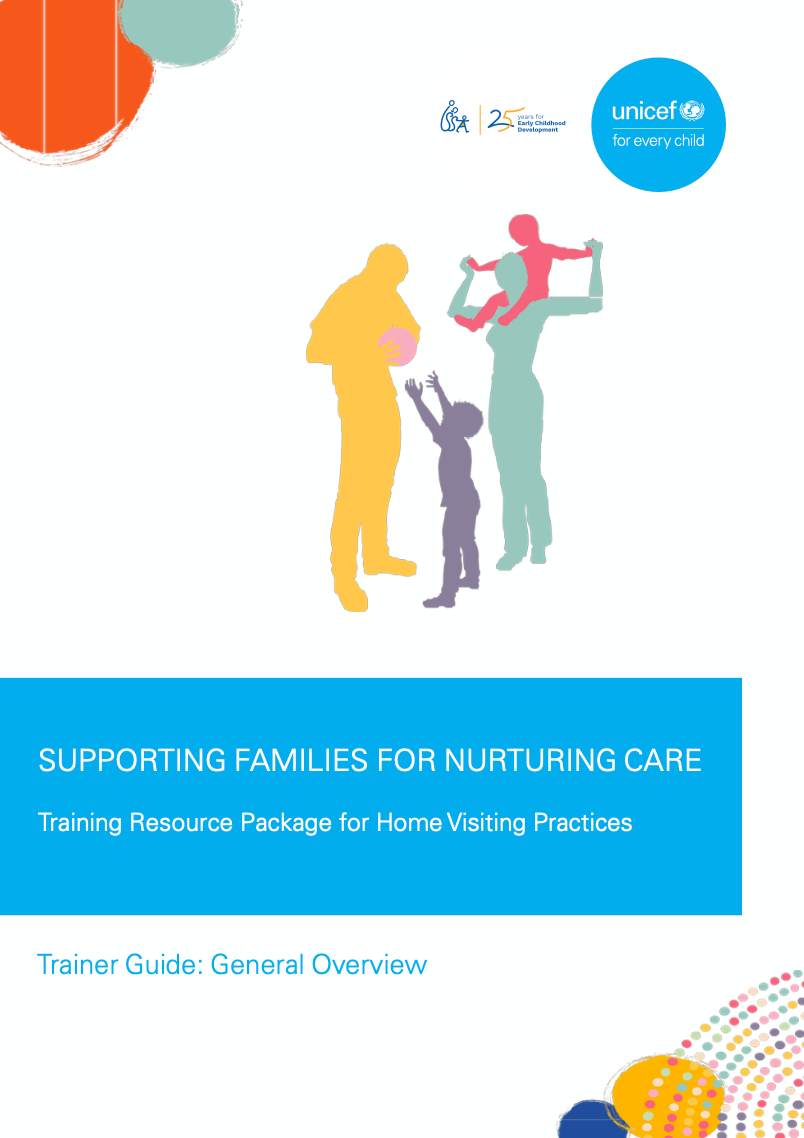
Supporting families for nurturing care: Training resource package for home visiting practices
This training package equips trainers of home visiting professionals with essential knowledge, skills, and tools to deliver consistent, high-quality pre-service and in-service training.
Developed by UNICEF ECARO and the International Step by Step Association (ISSA), it builds on almost ten years of collaboration and earlier home visiting modules (2017–2025). The goal is to strengthen home visiting as a key community health service supporting families from pregnancy to early childhood.
The package includes three guides: General Overview, Foundational Training, and Extended Training, each offering adaptable materials such as session plans, slides, and handouts based on nurturing and family-centered care.
It combines two main areas: (1) programmatic knowledge on child development, health, nutrition, and parental wellbeing, and (2) practical skills such as communication, relationship building, observation, problem-solving, and cultural responsiveness.
Grounded in adult learning principles, the training encourages reflection, peer learning, and practical application, fostering the professional growth of trainers and home visitors while improving the quality of home visiting services.
Trainer Guide: General Overview
Trainer Guide: Foundational Training
Day 1 PPT | PDF
Day 2 PPT | PDF
Day 3 PPT | PDF
Day 4 PPT | PDF
Day 5 PPT | PDF
Trainer Guide: Extended Training
Day 1 PPT | PDF
Day 2 PPT | PDF
Day 3 PPT | PDF
Published in:
2025
Organization(s):
ISSA, UNICEF ECARO
Language:
Contact:
Ayca Alayli, aalayli@issa.nl