Knowledge Hub
All the resources stored here have been created by ISSA Members
or ISSA Secretariat in partnership with Members or partners.



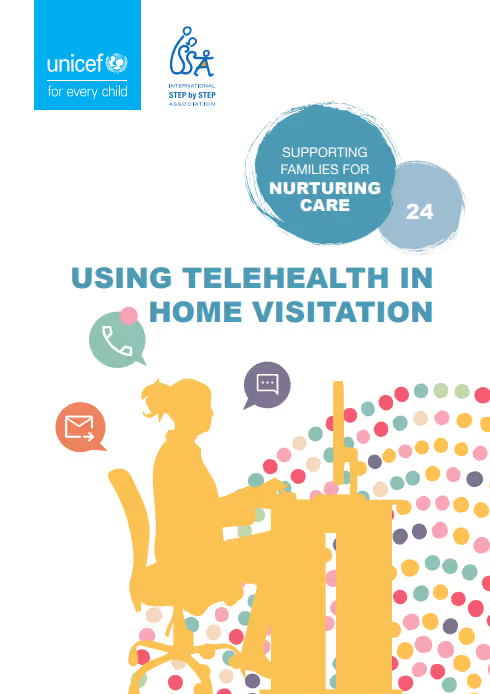
Module 24: Using Telehealth in Home Visitation
The term telehealth intervention implies the use of electronic platforms or apps such as telephone calls, video meetings and conferences, text messaging, the use of various online apps and social media tools or content presented on online platforms as resources utilised to provide support to individuals or families.
Module 24 aims to enable reflection on the ways in which telehealth resources can enrich current family support programs based on home visits, including the polyvalent home visiting services in working with families expecting children or providing care for young children.
You can access the whole package here.
Published in:
2023
Organization(s):
UNICEF ECARO & ISSA
Language:
Contact:
Zorica Trikic, ztrikic@issa.nl
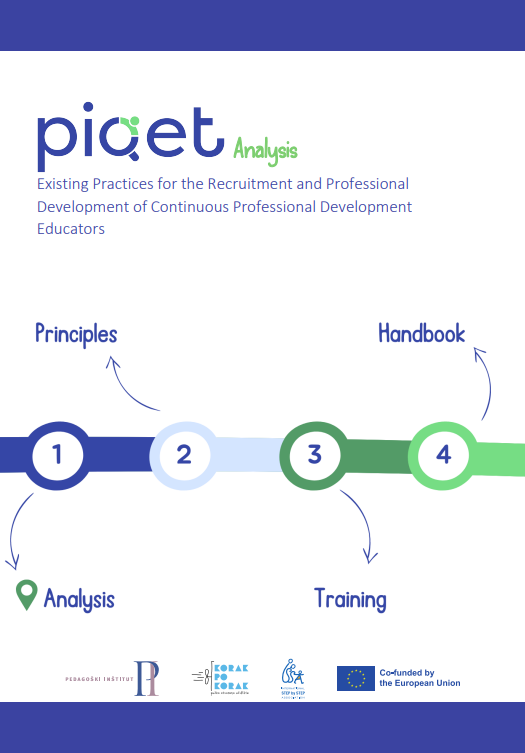
Existing Practices for the Recruitment and Professional Development of Continuous Professional Development Educators
Published in:
2023
Organization(s):
Educational Research Institute, Open Academy Step by Step, International Step by Step Association
Language:
Contact:
Aljoša Rudaš, arudas@issa.nl
BE KINDER: unravelling paths to address gender stereotypes in education and early childhood
This book brings together some of the KINDER project’s key contributions to the construction of a transformative and gender-sensitive education. It offers a set of common learning experiences developed by the KINDER international partners, which must be shared as a starting point for policies and programmes aiming at integrating gender issues at an early age at national and European level.
The chapter, Positive gender socialisation at home and school for transformative change, was authored by the ISSA Secretariat's Progam Director, Dr. Mihaela Ionescu, and Junior Program Manager, Ayça Alaylı. It emphasizes the importance of positive gender socialization (PGS) beginning from early years for each child to develop holistically and reach their unique potential. The main aim of the chapter is to provide a deeper understanding on gender transformative approaches and the pathways of applying gender transformative methodolologies in parenting and education, to promote PGS. The chapter examines the concepts, but also provides practical recommendations for parents and practitioners.
Published in:
2023
Language:
Contact:
Ayça Alaylı, aalayli@issa.nl
Toolkit to bring play and inclusion to refugees living in remote communities
Mobile Play Hubs are a more flexible and immediate response to offer high-quality nonformal educational support to children and families. The below resources are intended for organisations wishing to set up and run Mobile Play Hubs for children aged 0 to 10 years old. It is also useful to regular Play Hubs and other non-formal ECEC settings that want to make (outdoor) play more accessible to children of all ages.
The Toolkit is divided into two parts (Operating guidelines and 16 Activity cards) with which practitioners will be able to set up a Mobile Play Hub and increase their knowledge about different forms of outdoor play. The Activity Cards provide inspiration to make outdoor play as accessible as possible.
You can download “Mobile Play Hub – Operating Guidelines and Outdoor Play” and the “Mobile Play Hub – Activity Cards” in English, Hungarian, Slovak, and Ukrainian.
Published in:
2023
Organization(s):
ICDI
Language:
Contact:
Giulia Cortellesi, giulia@icdi.nl
Published in:
2023
Organization(s):
UNICEF ECARO & ISSA
Language:
Contact:
Zorica Trikic, ztrikic@issa.nl
Elements and Pathways to Establish Professional Learning Communities for Early Childhood Professionals
In the dynamic landscape of early childhood professional development, the traditional, one-size-fits-all approaches have proven insufficient, often disconnected from the real-world context in which professionals operate. Recognizing the limitations of top-down decision-making and isolated learning methods, the concept of Professional Learning Communities (PLCs) emerges as a transformative approach. The overarching goal of PLCs is to foster a collaborative, adaptive environment where professionals can collectively pursue common goals and purposes, ultimately enhancing the quality and impact of their work in early childhood settings.This resource is developed by ISSA staff, under the Health Systems for Early Child Development Initiative, and tailored specifically for professionals working with young children and families across sectors, emphasizing the power of PLCs in fostering sustainable, high-quality practices through collaborative and ongoing peer support.This guide depicts the essential elements of PLCs, offering a roadmap for setting up and efficiently managing these communities. While the concept of PLCs has deep roots in the educational realm, its applicability has expanded into the health and social sectors, addressing the unique needs of those working with young children and families. This guide also illustrates the application of PLCs in early childhood education and health settings, using relevant examples. These examples serve as models for the creation and sustainability of a PLC, underscoring the flexibility of the content to align with the diverse professional priorities and needs of PLC members across various sectors.
Published in:
2023
Organization(s):
International Step by Step Association
Language:
Contact:
Zorica Trikic, ztrikic@issa.nl
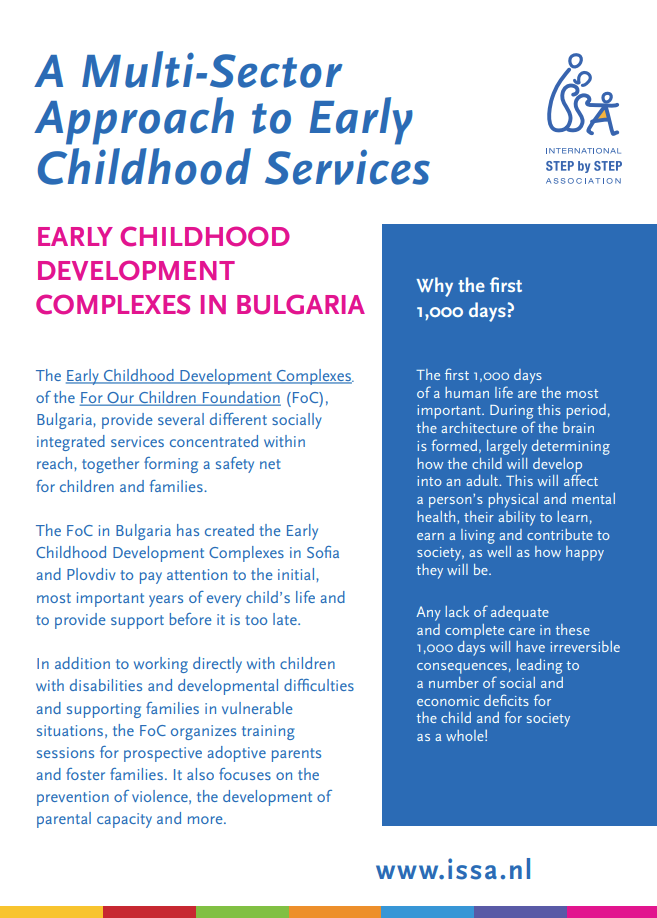
Early Childhood Development Complexes: A multi-sector approach to early
This case study is based on the Early Childhood Development Complexes of For Our Children Foundation (FoC), Bulgaria, that provided several different socially integrated services concentrated within reach, which together form a safety net for children and families. FoC in Bulgaria created the Early Childhood Development Complexes in Sofia and Plovdiv to pay attention to the first, most important years of every child's life and to support them when it is not too late. In addition to working directly with children with disabilities and difficulties in the development and supporting families in vulnerable situations, FoC organized trainings for prospective adoptive parents, foster families, as well as for prevention of violence, development of parental capacity and more.
Published in:
2023
Organization(s):
For Our Children Foundation
Language:
Contact:
Ayça Alaylı, aalayli@issa.nl
Group reflection as a motor for high-quality educational practice. An inspirational travel guide for practitioners and leaders in ECEC and primary schools
This Guide will help you get familiar with the collaborative reflective practices of educators working in Early Childhood Education Centres (ECEC) and primary schools. It is intended for both ECEC professionals and leaders interested in finding out more about professional learning communities, how they operate, how different reflective methods help educators and how to set one up in your educational setting.
The Guide is developed within the Reflection, Cooperation, Group Support (REC) international project funded by the European Union with the aim of introducing collaborative reflective methods for educators and other professionals working with children aged 0-10 in a total of ten child-care and educational centres in Belgium (Flemish Community), Croatia, Hungary and Slovenia. It is grounded on national experiences of the consortium partners, their collaborative reflective practices in different educational systems (e.g. split and integrated ECEC systems), as well as on international research findings. Through our joint experience, we share the voices of numerous educators who, based on their experiences, advocate for the opportunity to be a part of the reflective group within their comprehensive, supportive and continuous professional development.
Published in:
2023
Organization(s):
Partners Hungary Foundation, Open Academy Step by Step, Centre for Innovation in the Early Years (VBJK), Artevelde University of Applied Sciences, Step by Step Centre for Quality in Education
Language:
Contact:
Flora Bacso, bacsof@partnershungary.hu
Published in:
2023
Organization(s):
ISSA
Language:
Contact:
Dr. Mihaela Ionescu, mionescu@issa.nl
The MANDELA model for Early Childhood Education and Care
The MANDELA model for Early Childhood Education and Care is a framework to place inclusivity at the heart of practice with babies, children, and families. It recognises the importance of relationships and belonging and ensuring environments reflect this. It also acknowledges that if we change the start of the journey, we can change educational outcomes for children that can impact across their life course.
The MANDELA way is not about prescription it is about FREEDOM and the workbook uses the word MANDELA to frame questions to enable a deeper understanding of practice to emerge, develop developmental plans and then embed a practice that is constantly evolving:
- Make Time– to really understand the community that uses the setting-staff, children, families. Use this information to shape different conversations, develop relationships, co-construct action plans and ensure they are enacted.
Acknowledge- is about striving for inclusivity in all we do through acknowledging our Needs, Differences, Education, Life experiences and Age. - Needs – what are the different needs of those using the setting, remembering people have the right not to share. How can you ensure the setting in inclusive of all needs? How do staff know and feel their needs are being addressed? How do parents and carers know their child’s needs will be met?
- Difference – this is about recognising we are all different. How do I know I am safe in you setting? Do you see me? Do you value who #I am?
- Education Experiences- acknowledging previous education experiences, providing training and further development of staff. Supporting parents and carers develop their knowledge about child development.
- Life Experience – our journey are all different, how to we value these and how do we create safe environments for people to use and work. How do we ensure are staff are safe practitioners? How does the setting value family diversity and the different experiences of the children using the setting?
- Age -how does the setting value people of different ages. What is its approach to intergenerational sharing? Does it know how age is viewed in different culture?
To learn more about the MANDELA Model, listen to this podcast episode with Dr Prospera Tedam who developed the Model, and Professor Eunice Lumsden who designed the Unique Childhoods Workbook. In the episode, they discuss these tools and how they can be used to support connection and build trust, deepening our anti-discriminatory practice and bringing about change in early childhood education.
Published in:
2023
Organization(s):
University of Northampton Tapestry Foundation Stage Forum
Language:
Contact:
Professor Eunice Lumsden; eunice.lumsden@northampton.ac.uk
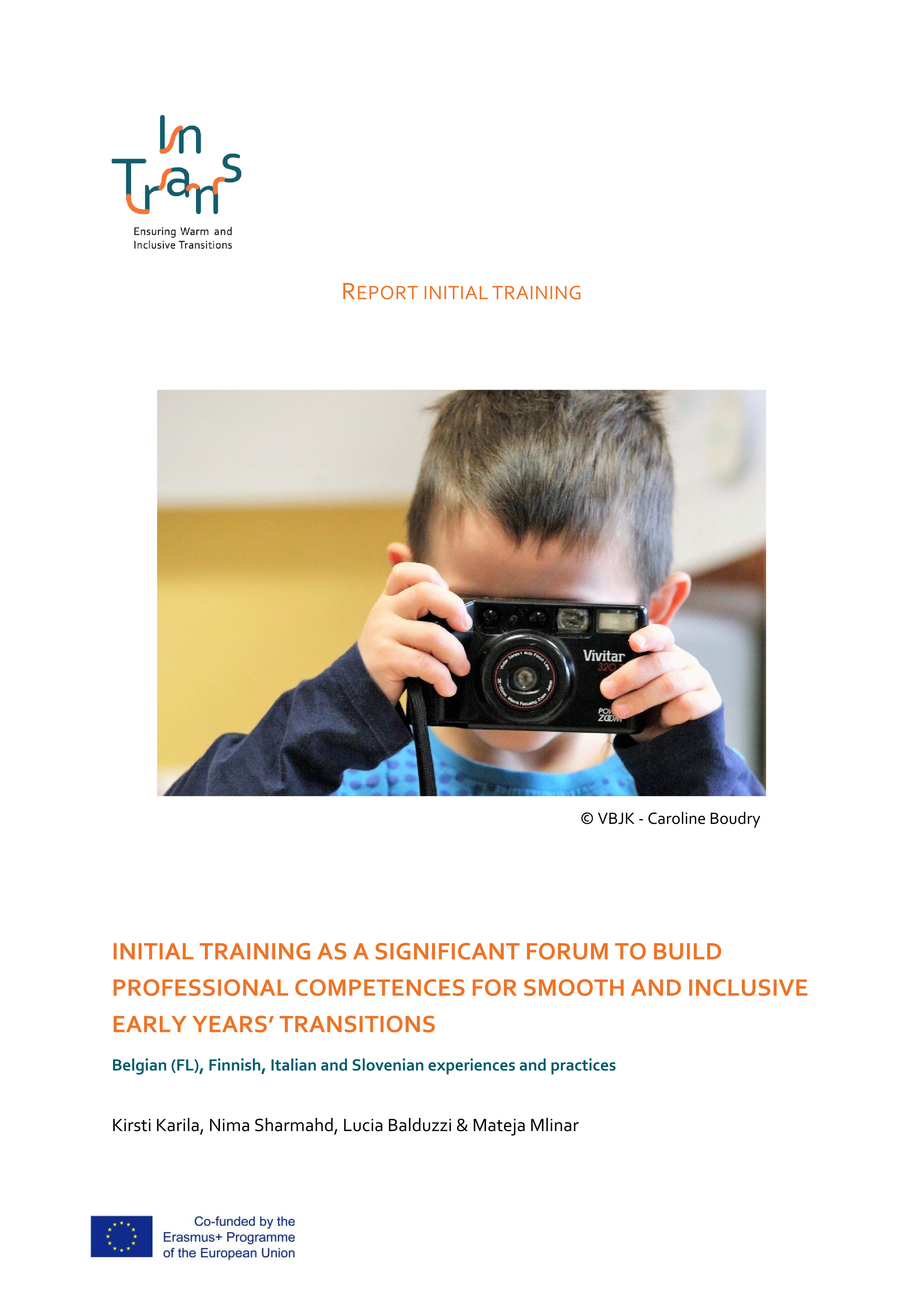
Initial training as a significant forum to build professional competences for smooth and inclusive early years’ transitions
InTrans project aims to support professionals through action at the policy, advocacy and training levels to ensure that all children and families experience warm and inclusive transitional practice in ECEC and school.
This project initiated the debate on curricula alignment of different professional student profiles in relation to transition, child image and parent image, resisting the top down schoolification pressure and school-readiness thinking.
InTrans studied how the various pre-service learning environments understand and implement the inclusive transitions taking place in early childhood education, preschools, pre-primary education, and primary schools. In addition, it investigated how the pre-service training’s curricula and pedagogical practices related to the inclusive transition could be improved.
InTrans consortium produced a comparative report bringing together findings from Belgium (Flemish Community), Finland, Italy, and Slovenia on the role of transitions in the curricula for pre-service professionals in training. Individual country reports can be also be downloaded here.
Published in:
2023
Published in:
2023
Organization(s):
ICDI
Language:
Contact:
Giulia Cortellesi, giulia@icdi.nl

InTrans Policy Baseline Reports
The ultimate goal of the InTrans project is to ensure that all children and families — especially the most vulnerable — benefit from warm and inclusive transitional practice in ECEC and school.
To achieve this goal, the project is supporting professionals through action at the policy, advocacy, and training levels.
At the level of policy and governance, InTrans has been facilitating activities to create awareness, knowledge development, and exchange for national and international policymakers to help them develop a shared vision on warm and inclusive transitions and corresponding policy measurements.
More concretely, the project has conducted policy analysis research in each of the four countries involved (Belgium, Finland, Italy and Slovenia). The result is the policy country reports that can be downloaded here.
In addition, together with a cross-country analysis executive summary report, a set of infographics has been created to provide an overview of the present state of early childhood care and education systems in each country (including Denmark).
Available in English.
Published in:
2022
Organization(s):
VBJK, Step by Step Centre for Quality in Education
Language:
Contact:
Katrien van Laere, katrien.van.laere@vbjk.be
Parenting on the Move: empowering parents to best support their children through migration and refugeehood
Parenting on the Move (PoM) has been developed to help parents create an environment of resilience, well-being, and education for kindergarten and school age children during situations of migration and refugeehood. PoM offers psychosocial support, education, and entertainment, as well as encouraging family cohesion and intercultural exchange.
The program has three components: parent workshops, family workshops (led by trained moderators), and materials for activities that parents and children can engage in, in a family setting.
As a program package, PoM provides a comprehensive framework for implementing the program through a) training of the facilitators of the workshops; b) mentoring through the implementation; c) monitoring and evaluation.
Watch the interview about the program.
Published in:
2022
Organization(s):
CIP-Center for Interactive Pedagogy, Save the Children North West Balkans
Language:
Contact:
Milena Mihajlović, milena@cipcentar.org
Module 7: Parental Wellbeing
Module 7: PARENTAL WELLBEING is a part of the Home Visiting Resource Modules Supporting Families for Nurturing Care. You can access the whole package here.
Published in:
2022
Organization(s):
UNICEF ECARO & ISSA
Language:
Module 4: Falling in Love - Promoting Parent-Child Attachment
Module 4: FALLING IN LOVE - Promoting Parent-Child Attachment is a part of the Home Visiting Resource Modules Supporting Families for Nurturing Care. You can access the whole package here.
Published in:
2022
Organization(s):
UNICEF ECARO & ISSA