Some professional experiences stay with you long after the meetings end and the flights home are over. The two weeks I recently spent in Tashkent were one of those experiences.
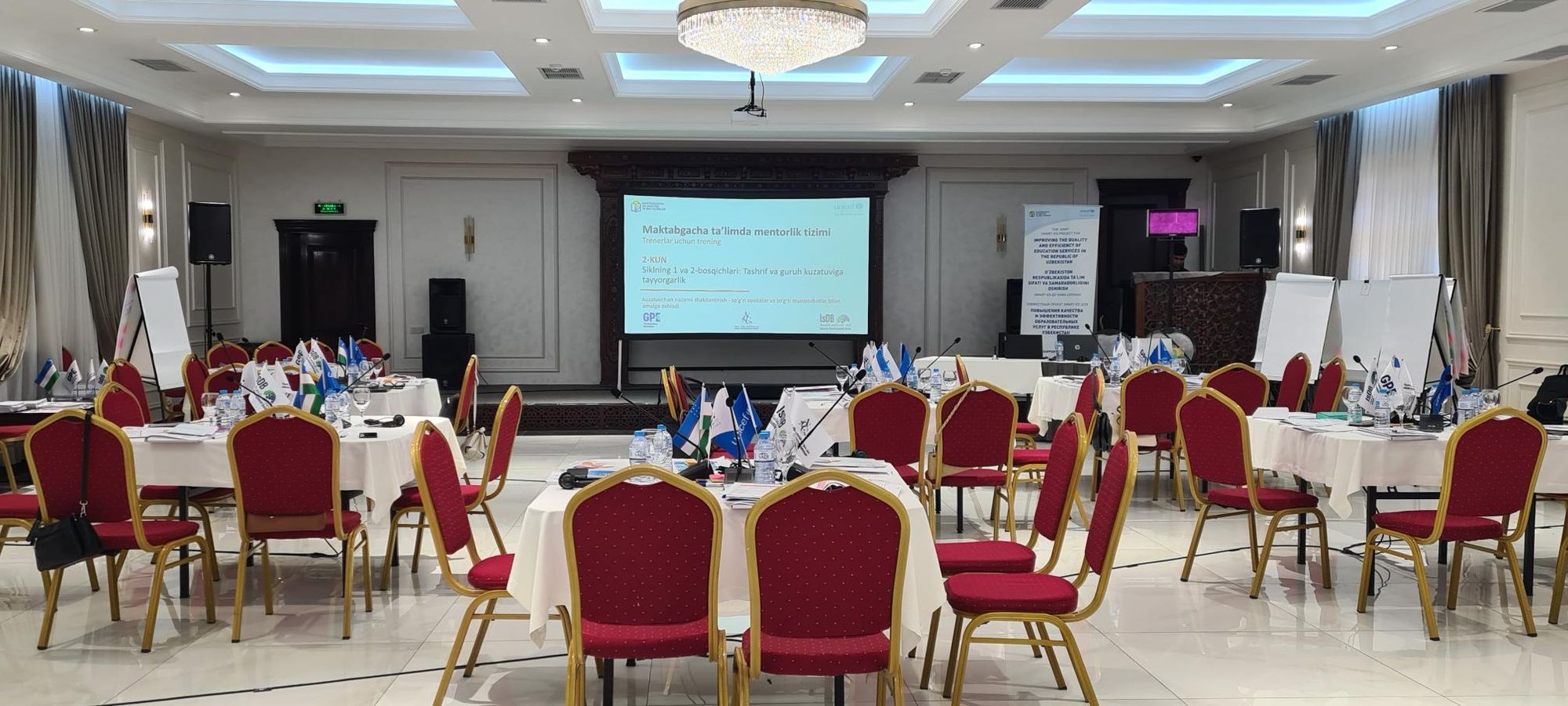
Together with an exceptional team of consultants – Margaret Kernan, Head of Programmes and Learning at the International Child Development Initiatives (ICDI), Aljosa Rudas, Program Manager at ICDI, Giulia Cortellesi, Co-Director at ICDI and Zorica Trikic, independent consultant -, I had the privilege of supporting UNICEF and the Ministry of Preschool and School Education (MOPSE) in Uzbekistan in developing and delivering the first national mentoring programme for preschool education. Over the past three months, we worked together on designing a comprehensive mentoring package: National Mentoring Framework, the Mentor Competency Framework, the Mentor's Handbook, a five-day Training of Trainers programme, a three-day Regional Mentor Training, practical tools, and learning resources. Seeing all of these pieces come together in practice was immensely rewarding.
None of this would have been possible without UNICEF Uzbekistan's outstanding preparation and leadership. From the thoughtful selection of participants to the organisation of the venue, high-quality simultaneous interpretation, and meticulous preparation of every training manual, handbook, and participant resource, the team created the conditions for meaningful professional learning. Their attention to detail and commitment to quality were evident throughout both weeks.
What impressed me most, however, were the people.
The Master Mentor Training brought together professionals with remarkably diverse backgrounds—teacher educators, deputy directors, inspectors, former inspectors, and education specialists. They arrived with years of experience in supporting teachers and improving quality within the preschool system. Yet what stood out was not only their expertise, but also their openness to question long-held assumptions, reflect deeply on their own professional identity, and embrace new ways of thinking.
One of the most powerful transformations during the training was the shift in how participants understood mentoring. For many, mentoring had initially been closely associated with supervision or inspection. Gradually, through discussion, practice, reflection, and repeated application of the mentoring cycle, mentoring became something quite different: a relationship built on trust, respect, psychological safety, and professional dialogue and driven by the goal of increasing quality and professionalism. Participants discovered that effective mentoring is not about telling teachers what to do; it is about creating the conditions in which teachers can reflect on their own practice, recognise their strengths, build confidence, and gradually improve their work.
Watching this shift unfold—captured in discussions, role plays, and the participants' own reflections—was perhaps the most rewarding part of the experience.
The timing could not be more important. Uzbekistan's preschool system is undergoing significant transformation, with the implementation of the revised Ilk Qadam curriculum and a growing emphasis on child-centred, inclusive, and competency-based approaches to teaching and learning. These changes require more than new policies or new materials. They require sustained professional support that helps teachers translate reform into everyday practice. Mentoring has the potential to become that bridge.
The second week, during the first Regional Mentor Training, demonstrated how this vision is beginning to take shape. This was the first of six regional trainings that will prepare more than 320 mentors across the country. These mentors, in turn, will support thousands of preschool teachers as they strengthen their practice and accompany children through richer, more responsive learning experiences. Twenty Master Mentors will guide and support this growing network, creating a sustainable system of professional learning that extends far beyond any single training event.
What gives me confidence is not only the quality of the mentoring model we have developed together, but the commitment of the people who will bring it to life. Over these two weeks, I saw professionals who are genuinely motivated to learn, eager to support one another, and determined to improve outcomes for young children. They are laying the foundations for a mentoring culture that values reflection over compliance, partnership over hierarchy, and continuous learning over one-off training.
System change is rarely achieved through a single initiative. It grows through people who are willing to learn, to lead, and to support others in doing the same. I left Tashkent convinced that Uzbekistan has begun building exactly that kind of community.
ISSA signed a partnership with UNICEF Uzbekistan for providing technical assistance in the development and introduction of a mentoring system in the preschool system in Uzbekistan. The technical assistance is coordinated by ISSA and provided in partnership with ICDI.
The partnership between ISSA, UNICEF and the Ministry of Preschool and School Education (MOPSE) in Uzbekistan is implemented within the framework of the SmartED project funded by the Islamic Development Bank, Arab Coordination Group, and Global Partnership for Education