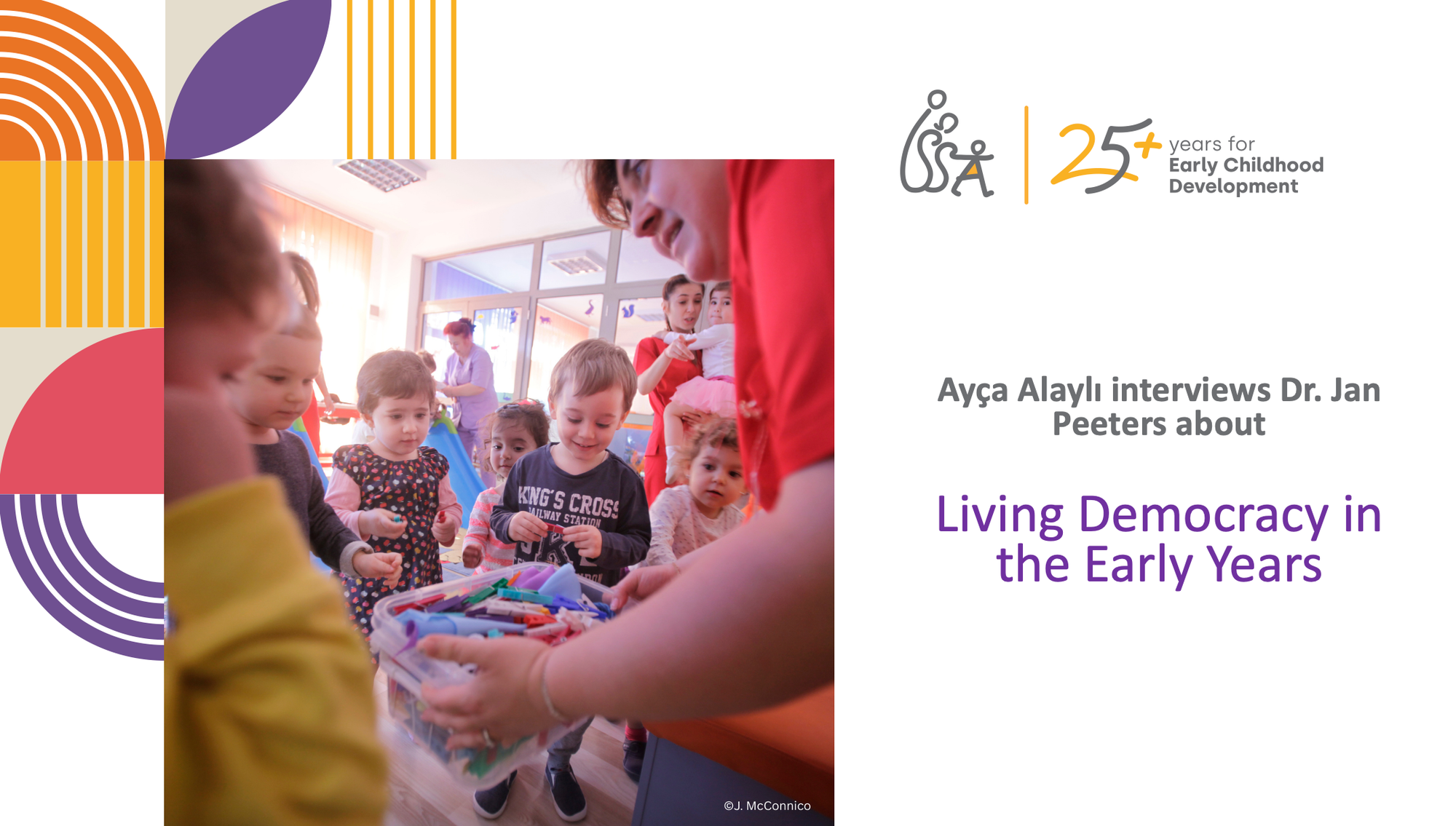
ISSA Program Manager Ayça Alaylı spoke to Dr Jan Peeters about how democratic values can be strengthened in early childhood settings, and why this work matters amid growing social and political pressures across Europe.
🎥 Listen to the interview here.
Jan reflected briefly on early influences that shaped his thinking, including participatory school initiatives, as well as his involvement in writing the recently published Early Childhood Education in Social and Political Transitions: The Legacy of the Open Society Foundations Step by Step Program, which documents how democratic and inclusive approaches took root in varied contexts. These experiences inform his understanding of “living democracy” as something expressed not in statements or frameworks, but in everyday interactions between teachers, children, and families.
What living democracy means in practice
For Jan, democratic practice relies on three interconnected elements. First is collective responsibility among professionals, where every staff member feels accountable for the pedagogical approach. He recalls a teacher who described her role as “being myself, and at the same time making a difference for the other,” a phrase he sees as capturing the balance needed for democratic work.
Second is children’s agency. Supporting children to ask questions, make choices, negotiate, and participate in decisions helps them understand themselves as active contributors, not passive recipients. Here Jan refers to John Dewey’s well-known reminder that “democracy needs to be born anew every generation, and education is its midwife.” Jan believes that early childhood settings are where that renewal tangibly begins.
The third element is ensuring all parents have influence, including those in disadvantaged situations or who speak other languages at home. Without deliberate efforts to include their perspectives, Jan argues, participation becomes selective rather than democratic.
These principles take on added significance at a time when terms such as diversity and inclusion are being removed from policy documents in some countries, narrowing the space for equitable practice.
Conditions that support democratic participation
Across settings Jan has observed, from Pistoia to Step by Step centres to schools in Ghent, certain patterns consistently appear. Reflective dialogue within teams enables staff to learn from one another and refine their shared approach. Documentation helps build shared values with families. Collective ownership ensures responsibility for decision-making does not sit solely with leadership. And an emphasis on children’s rights and respect for diversity makes participation meaningful for every child.
Jan shared a small example from Ghent that illustrates this work in action. When younger children expressed sadness that their older friends no longer played with them after moving to primary school, the issue was taken to the children’s parliament. The resulting changes show how children’s voices can shape institutional decisions.
Challenges and priorities going forward
Jan also stresses that father participation must be treated as a core part of democratic practice, not an optional add-on. Many early childhood settings default to mothers as the primary contact, which restricts who participates in children’s learning. Designing everyday interactions that intentionally include fathers is essential, he says, for a genuinely democratic environment.
Despite the familiar pressures of workload, limited funding, and political shifts that constrain inclusive practice, Jan sees committed practitioners and learning communities continuing to defend democratic approaches. Looking ahead, he believes the priority is moving from broad principles to practical, peer-to-peer learning. Sharing concrete examples, creating space for team reflection, and building a coherent set of shared values are, in his view, the conditions that allow democratic practice to take root and endure.
Watch the interview here.
Jan Peeters is a Senior Researcher and Consultant in Belgium, collaborating with the Centre for Innovations in the Early Years, Fair Start Stories, international organisations, foundations, and NGOs, including in Eastern Europe. A former Senior Researcher at Ghent University’s Department of Social Pedagogy and Social Work, he co-founded VBJK in 1986 and pioneered the use of film in professional development while advancing the discussion on men in childcare. He has contributed to numerous international projects, films, and publications. His doctoral work and book The Construction of a New Profession examine competent systems and organisational quality. His key areas include professionalization, transitions, and ensuring a strong start in pre-primary education.