By Professor Janja Župančič
Contemporary society is characterized by continuous technological, social, and cultural change, which is inevitably reflected in educational systems. Within such a dynamic context, increasing emphasis is placed on the quality of interpersonal relationships as a fundamental component of effective teaching and professional practice. Consequently, soft skills have emerged as a critical dimension of educators’ professional competence.
Unlike technical and academic knowledge, soft skills encompass a range of personal and socio-emotional competencies manifested through communication, collaboration, conflict resolution, adaptability, and leadership. These competencies are inherently complex and difficult to assess through standardized measures, as they develop primarily through experience, reflection, and interpersonal interaction.
In educational settings, soft skills are particularly important because of the relational nature of pedagogical work, which involves constant interaction with children, colleagues, families, and the wider community. Educators who demonstrate well-developed soft skills are better equipped to create safe, supportive, and stimulating learning environments in which children feel valued, respected, and motivated to engage in learning.
Soft skills function as a bridge between knowledge and its effective application in everyday practice, enabling educators to respond appropriately to complex and dynamic classroom situations. In the absence of strong soft skills, even high levels of subject-specific expertise may remain underutilized
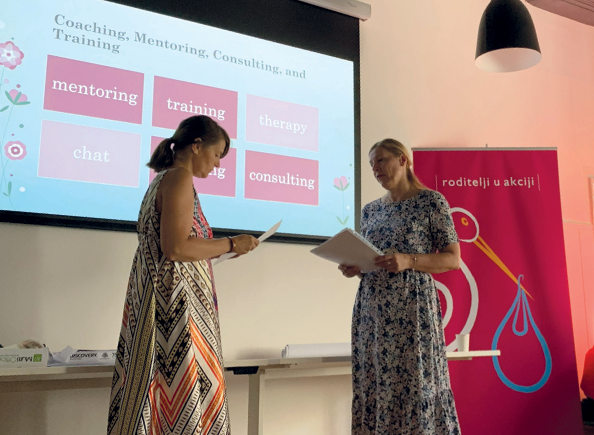
Training of trainers in Zagreb, 2024.
Changing Paradigms in Teaching and Leadership
Recent developments in education show a shift away from traditional hierarchical and authoritative models toward more democratic, participatory, and collaborative approaches. Communication is increasingly understood as a reciprocal process grounded in trust, mutual respect, and shared responsibility.
Within this paradigm, the role of educators and leaders is undergoing a significant transformation. Rather than acting as controllers or authoritative figures, they assume the role of facilitators who support learning processes, foster participation, and empower individuals and groups. This shift places greater emphasis on well-being, professional growth, and the quality of interpersonal relationships within educational institutions.
Reflective Practice as a Core Component
Reflective practice is a central aspect in the development of soft skills. Systematic reflection on one’s own actions, communication patterns, and professional decisions increases self-awareness, empathy, and adaptability.
Through reflective processes, educators gain deeper insight into their practice, identify areas for improvement, and develop more effective strategies for engaging with learners and colleagues. This ongoing process of reflection and adaptation supports continuous professional development and contributes to the overall quality of education.
The Role of Soft Skills in Professional Practice
Soft skills encompass a broad spectrum of competencies, including effective communication, empathy, active listening, teamwork, critical thinking, problem-solving, and adaptability. These skills are essential for functioning effectively in complex social and professional environments.
In early and primary education in particular, the quality of relationships significantly influences children’s learning and development. Educators serve as role models, and their demonstration of soft skills directly contributes to the development of children’s socio-emotional competencies.
The Project “Soft Skills for High-Quality Education”
The growing recognition of soft skills in education is reflected in various international initiatives aimed at strengthening these competencies among educators. One such initiative focuses on the development and enhancement of soft skills as a means of improving educational quality.
The project is grounded in the understanding that high-quality education cannot rely solely on academic knowledge but must also incorporate the development of emotional and social competencies. Particular emphasis is placed on reflective practice, empathy, communication skills, and collaborative approaches in working with both children and adults.
Within this framework, a range of activities and methodologies are implemented to support educators in developing their soft skills. These efforts contribute to the formation of professional learning communities in which knowledge is shared, critically examined, and continuously improved.
Findings from such initiatives indicate that strengthening soft skills leads to the creation of inclusive, supportive, and emotionally safe learning environments, while also enhancing the quality of relationships within educational settings.
Future Perspectives
Educational systems increasingly acknowledge the need to integrate soft skills into curricula and professional development programs. There is a gradual shift from an emphasis on individual achievement toward collaboration, collective learning, and community-building.
This transformation also reflects a broader change in educational philosophy: from individualism to cooperation, from competition to collaboration, and from passive knowledge acquisition to active participation in learning processes.
Soft skills are not an optional addition to professional competence but rather its foundation. They enable the effective application of knowledge, foster meaningful relationships, and support the creation of enriching learning environments. By developing soft skills, educators not only enhance their own professional practice but also contribute to the development of more inclusive, empathetic, and collaborative societies.