Knowledge Hub
All the resources stored here have been created by ISSA Members
or ISSA Secretariat in partnership with Members or partners.



Task of communicating with a child. Control or self-control
During the lockdown, the Child Development Institute at Ilia State University continued its activities by providing services at the distance. All distance interventions included parents or other family members. In order to support their work at home, specialists were designing tailored activities for children with Autism Spectrum Disorder (ASD). Written visual materials alongside phone or online guidance were provided to any the family who was willing and able to participate in such an exchange.
Online connections have led to more close contact with family members identifying some areas which needed an urgent response. Therefore, the team of specialists designed distance parent education courses and invited all parents to engage. Talks were transferred on ISU’s page. The Institute Talks were held in Georgian on a weekly basis.
Published in:
2020
Organization(s):
Child Development Institute, Ilia State University
Language:
Contact:
Khatuna Dolidze, khatuna.dolidze.1@iliauni.edu.ge

Published in:
2020
Organization(s):
Association 21 July
Language:
Contact:
Francesca Petrucci, educazione@21luglio.org
Supporting the collaboration between ECEC core and assisting practitioners: Experiences of two Belgian pilot schools
In this Belgian Pilot Report, conducted as part of the VALUE project, we examine how collaborative learning between ECEC core and assisting practitioners can be supported as part of sustainable CPD (Continuous Professional Development) path in the context of Flemish community of Belgium.
button[src="https://cdn.prod.website-files.com/694724257114b734f4bb749a/6985cf93cfe21592332c5a0b_4th%20PINN%20Report%20final.pdf"][label="Download"]Published in:
2020
Organization(s):
VBJK - Centre for Innovation in the Early Years, ERI - Educational Research Institute
Language:

Supporting the collaboration between ECEC core and assisting practitioners: Experiences of professional learning communities in two Slovenian pilot kindergartens
The purpose of this report is to demonstrate development and implementation of a common path of professional development for professionals: ECEC core and assisting practitioners in two Slovenian kindergartens involved in the VALUE project.
The aim of the VALUE project was to create a ‘path of continuous professional development (CPD) for all kindergarten professionals, to improve collaboration between ECEC core and assisting practitioners, and at the same time to recognize the diversity according to their background and experience. In this respect, the VALUE project aims to improve collaborative practices in order to address the needs of all children, families and communities.
button[src="https://www.value-ecec.eu/wp-content/uploads/2020/11/Country-Report_single-page_SL.pdf"][label="Download"]
Published in:
2020
Organization(s):
VBJK - Centre for Innovation in the Early Years, ERI - Educational Research Institute
Language:
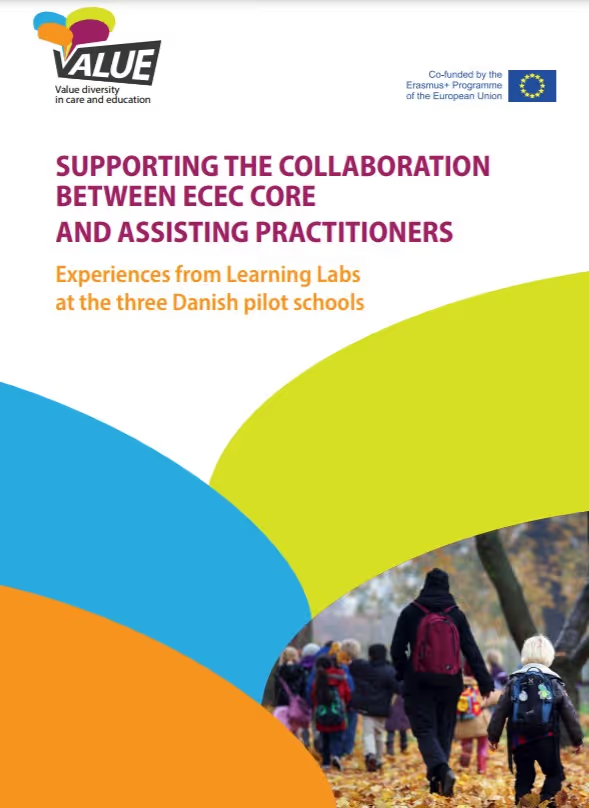
Supporting the collaboration between ECEC core and assisting practitioners: Experiences from Learning Labs at the three Danish pilot schools
This report examines the question "How can professional development in learning laboratories enhance professional identity, a holistic perspective approach to education and care (educare) and collaboration among and between core and assisting practitioners within Danish ECEC settings?"
Overall, VALUE aims to support diversity and democracy among children through coordination of pedagogical activities and exchange of experiences among and between those working with the children: both core and assisting practitioners. It is assumed that focusing on the conditions for ECEC professionals’ work, such as their expertise and the resources available, will lead to better opportunities for successful collaboration between these groups.
Published in:
2020
Organization(s):
VBJK - Centre for Innovation in the Early Years, ERI - Educational Research Institute
Language:

Supporting the collaboration between ECEC core and assisting practitioners: endline report of the VALUE project in four countries
In this VALUE endline report, the following question is examined: How can continuous professional development (CPD) strengthen professional identity, holistic approaches to educational work (educare) and cooperation between core and assisting practitioners working within the field of Early Childhood Education and Care (ECEC)? This question is explored through pilot projects conducted by research groups located in four different countries (Belgium, Denmark, Portugal and Slovenia). The report highlights the findings from the pilot projects in the four countries.
The report first presents the different VALUE pilot projects as snapshots from the four countries. It is then followed by a description of the overall lessons learned from the projects and the insights that emerged regarding important conditions at both policy and practice levels, which can be used as a framework for the future development of CPD at all levels of ECEC. Finally, we present our conclusions and make a number of recommendations based on the descriptions and examples in this VALUE endline report.
button[src="https://www.value-ecec.eu/wp-content/uploads/2020/12/Endline-Report_single-page_V3.pdf"][label="Download"]Published in:
2020
Organization(s):
VBJK - Centre for Innovation in the Early Years, ERI - Educational Research Institute
Language:

Supporting the collaboration between ECEC core and assisting practitioners: Experiences of contextual professional development in two Portuguese pilot schools
In this report we present a description and reflection of the learning path carried out in Portugal, by the teams of Lisbon and Santarém. After a previous contextualization about the ECEC system in Portugal, we share information on the two institutions where the pilot studies took place (one located in Lisbon and the other in Santarém).
The contents and methodologies of each learning path are presented through the description of the processes and learning carried out in each pilot. Both contents and methods were jointly defined by the teams of Lisbon and Santarém based on the objectives set out by the Value Project.
Finally, the report summarizes the findings and information resulting from the initial baseline, individual portfolio and focus group interviews carried out at the end of the learning path. This includes the main issues pointed out as well as an analysis of the aspects to be considered for the continuity of a consistent path of collaboration between ECEC core and assisting practitioners.
Published in:
2020
Organization(s):
VBJK - Centre for Innovation in the Early Years, ERI - Educational Research Institute
Language:
Roma community in Macedonia during the crises with COVID-19
During the pandemic, the NGO “KHAM" Delcevo had an important role to play in raising awareness among the Roma community about how to be protected from COVID-19. In order to achieve our objectives we implemented online education for pregnant women about going to the Gynecologist and taking care of their children’s physical and mental health. Also, we supported Roma children living in poverty, and families with low income to attend the online education. Finally, we supported Roma families who were affected by the economic crisis to apply for social welfare benefits.
Together with Roma Health Network (Roma NGOs who are supported from OSF) who have monthly online meetings. In addition, all the difficulties that the community faces were presented to the Government via online meetings. With support from OSF, the Roma Network donated $130,000 to the Roma community. Finally, the community was benefitted from the brochures developed about how to be protected from COVID-19.
Published in:
2020
Organization(s):
NGO “KHAM" Delcevo
Language:
Contact:
Zoran Bikovski, z_bikovski@yahoo.com

Rainbows in Windows - Think Equal Sample
‘Rainbows in Windows’, co-written with the World Health Organisation, is a story focused on mental health and wellbeing and on how to keep healthy (physically and mentally) when faced with a virus.
This story includes a number of practical methods for emotional regulation and discusses complex feelings within an age-appropriate child-centred narrative. Additional features of this particular story include the gratitude to frontline workers, the normalization and regulation of “big feelings”, basic hygiene tips for Early Years children and, as always with Think Equal, illustrative representations of a diverse society.
This story is relevant as a Covid-19 response but ultimately has wider messaging and provides tools for children that transcend the context of the
recent pandemic.
button[src="https://cdn.prod.website-files.com/694724257114b734f4bb749a/6985cfc00eedb04db5b27a5d_Watermark%20rainbows%20in%20window%20book%20-%20Think%20Equal.pdf"][label="Download the story book"]
button[src="https://cdn.prod.website-files.com/694724257114b734f4bb749a/6985cfc0b64497b92fbd0574_Lesson%20Plan%20-%20Rainbows%20in%20Windows%20-%20Think%20Equal.pdf"][label="Download the lesson plan"]
button[src="https://cdn.prod.website-files.com/694724257114b734f4bb749a/6985cfc16ca73e3f96db8819_Home%20Kit%20-%20Rainbows%20in%20Windows_print%20-%20Think%20Equal.pdf"][label="Download the home kit"]
Published in:
2020
Organization(s):
Think Equal, World Health Organization
Language:
Contact:
Ruby Jewitt, ruby.jewitt@thinkequal.org
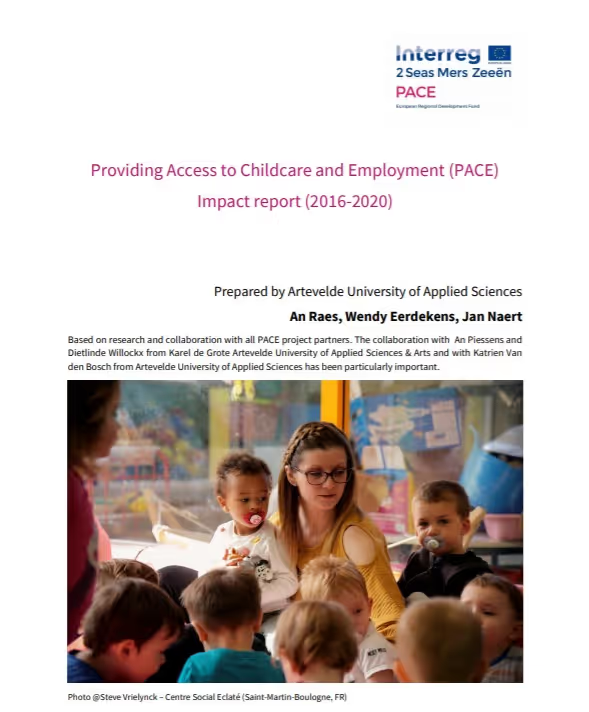
Providing Access to Childcare and Employment (PACE): Impact report (2016-2020)
This report outlines how the access to childcare and employment can be enhanced for families living in vulnerable conditions by investing in strong systems, organisations and staff. It highlights what measures can be taken to support families into childcare and employment and to enhance their overall quality of life.
Published in:
2020
Organization(s):
Artevelde University of Applied Sciences, Department of Early Childhood; Karel de Grote University of Applied Sciences and Arts
Language:
Contact:
An Raes, an.raes@arteveldehs.be
PINN - Report of 4th Learning Exchange Visit
Published in:
2020
Language:

Play in everyday life
During the lockdown, the Child Development Institute at Ilia State University continued its activities by providing services at the distance. All distance interventions included parents or other family members. In order to support their work at home, specialists were designing tailored activities for children with Autism Spectrum Disorder (ASD). Written visual materials alongside phone or online guidance were provided to any the family who was willing and able to participate in such an exchange.
Online connections have led to more close contact with family members identifying some areas which needed an urgent response. Therefore, the team of specialists designed distance parent education courses and invited all parents to engage. Talks were transferred on ISU’s page. The Institute Talks were held in Georgian on a weekly basis.
Published in:
2020
Organization(s):
Child Development Institute, Ilia State University
Language:
Contact:
Khatuna Dolidze, khatuna.dolidze.1@iliauni.edu.ge

Parent mediated interactions
During the lockdown, the Child Development Institute at Ilia State University continued its activities by providing services at the distance. All distance interventions included parents or other family members. In order to support their work at home, specialists were designing tailored activities for children with Autism Spectrum Disorder (ASD). Written visual materials alongside phone or online guidance were provided to any the family who was willing and able to participate in such an exchange.
Online connections have led to more close contact with family members identifying some areas which needed an urgent response. Therefore, the team of specialists designed distance parent education courses and invited all parents to engage. Talks were transferred on ISU’s page. The Institute Talks were held in Georgian on a weekly basis.
Published in:
2020
Organization(s):
Child Development Institute, Ilia State University
Language:
Contact:
Khatuna Dolidze, khatuna.dolidze.1@iliauni.edu.ge
Multilingual early childhood education and care for young refugee children
This is the Toolbox of the Erasmus+ project Multilingual early childhood education and care for young refugee children. In this project (2016-2019) the consortium made an inventory of the existing services, activities and programmes for young children from refugee and asylum-seeking families in the Netherlands, Belgium, Norway and the United Kingdom.
The Toolbox includes Country reports, Quality Indicators and Training packages.
Published in:
2020
Language:
Contact:
Eva Izsak, eizsak@issa.nl

Learning with Children
Published in:
2020
Organization(s):
Group for Children and Youth “Indigo”
Language:
Contact:
Tamara Simonovic, tamara@indigo.org.rs
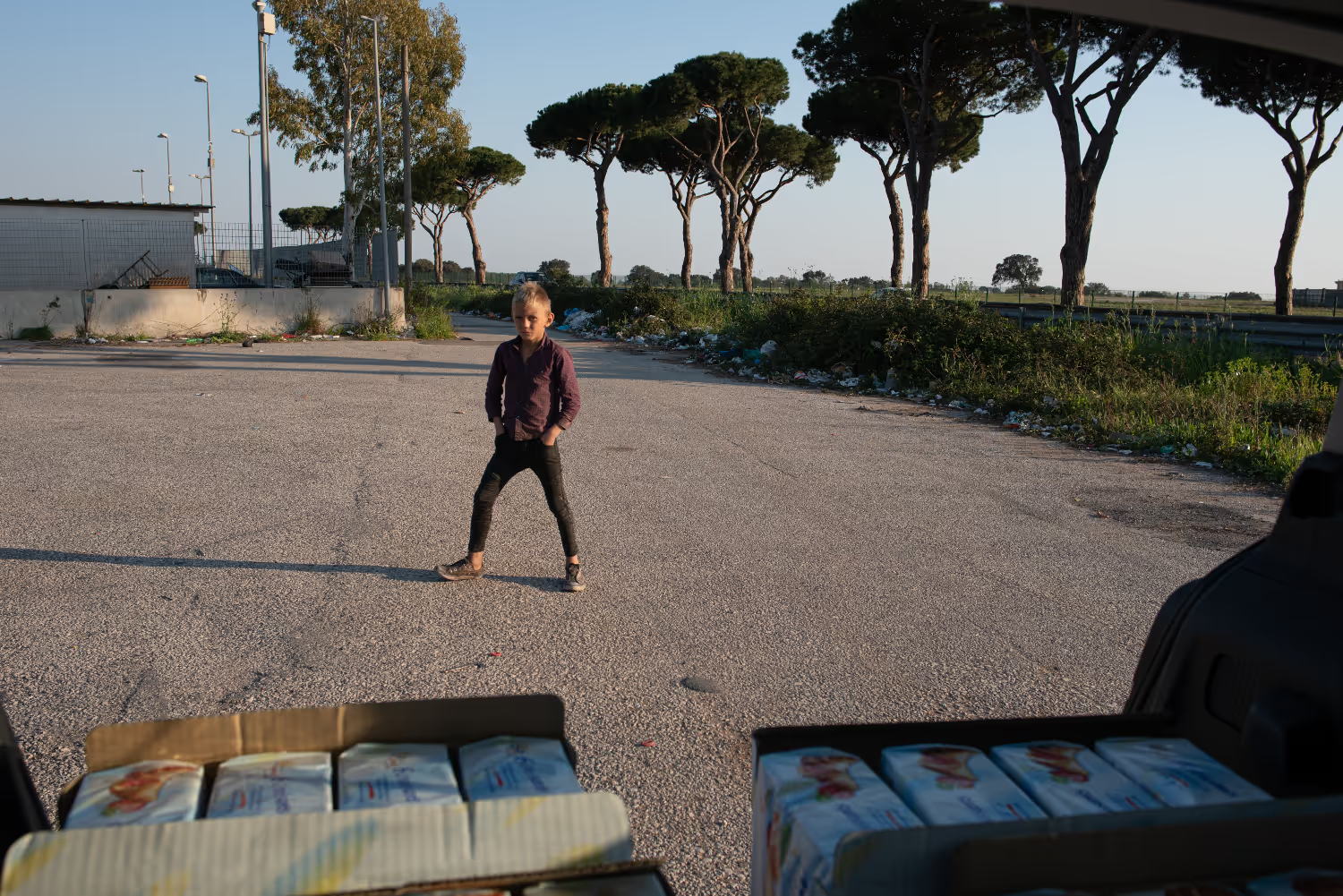
#IStayCamp. Health Conditions, Food Deprivation and Solidarity Problems in the First Days of Lockdown in the Roma Villages of Rome
As soon as the lookdown was declared by the Prime Minister, Associazione 21 luglio conducted a research to monitor the condition of Roma communities living in housing emergency in Rome.
Association 21 luglio carried out an investigation within the institutional Roma settlements in Rome, to understand how the COVID-19 emergency and the strict rules imposed by the Government to prevent the virus contagion, could impact on the Roma living in camps. Noteworthy results are that there are no health workers in the camps for the distribution of material or to provide information about Covid-19; families cannot go out to work and don’t have money to buy food; the suspension of school activities and the impossibility of using technological tools essential to follow distance education puts minors of school age in a state of serious isolation in relation to their peers and teachers. To face these health conditions of over 6000 people living in housing emergency in the camps in Rome, Associazione 21 luglio launched an appeal to the Mayor and the Prefect of Rome to map the conditions of greater fragility inside the formal and informal settlements with the main aim of guaranteeing the distribution of basic necessities, adequate hygienic-sanitary conditions and ensuring access to drinking water.
First lines of the research: On March 9, 2020, “in order to counteract and contain the spread of the Covid 19 virus,” Italian prime minister Giuseppe Conte signed a decree implementing a complete lockdown aimed at “avoiding any movement of individuals.” The government also recommended that stringent hygiene and sanitary measures be taken throughout the country. Associazione 21 Luglio (“July 21 Association”), began an applied research project aimed at understanding the impact of these measures in formal settlements in Rome, which are inhabited by families that generally define themselves—and are identified by the local authorities — as belonging to varied Roma communities.
This research revealed how such settlements struggle with public health concerns and access to food, among other deprivations, and underscores the need for emergency interventions. Those results allowed us to elaborate a strategy to contain the negative effects generated by the lockdown.
In our opinion, this resource can be used to inspire other association to use our methodology. Indeed, the research was the first step to implement a food aid program focused on the fight against food deprivation for children 0 to 3 years old living in poor Roma settlements.
Contact person: Francesca Petrucci, educazione@21luglio.org
Published in:
2020
Organization(s):
Associazione 21 luglio
Language:
Contact:
Francesca Petrucci, educazione@21luglio.org
How to support functional skills and independence
During the lockdown, the Child Development Institute at Ilia State University continued its activities by providing services at the distance. All distance interventions included parents or other family members. In order to support their work at home, specialists were designing tailored activities for children with Autism Spectrum Disorder (ASD). Written visual materials alongside phone or online guidance were provided to any the family who was willing and able to participate in such an exchange.
Online connections have led to more close contact with family members identifying some areas which needed an urgent response. Therefore, the team of specialists designed distance parent education courses and invited all parents to engage. Talks were transferred on ISU’s page. The Institute Talks were held in Georgian on a weekly basis.
Published in:
2020
Organization(s):
Child Development Institute, Ilia State University
Language:
Contact:
Khatuna Dolidze, khatuna.dolidze.1@iliauni.edu.ge
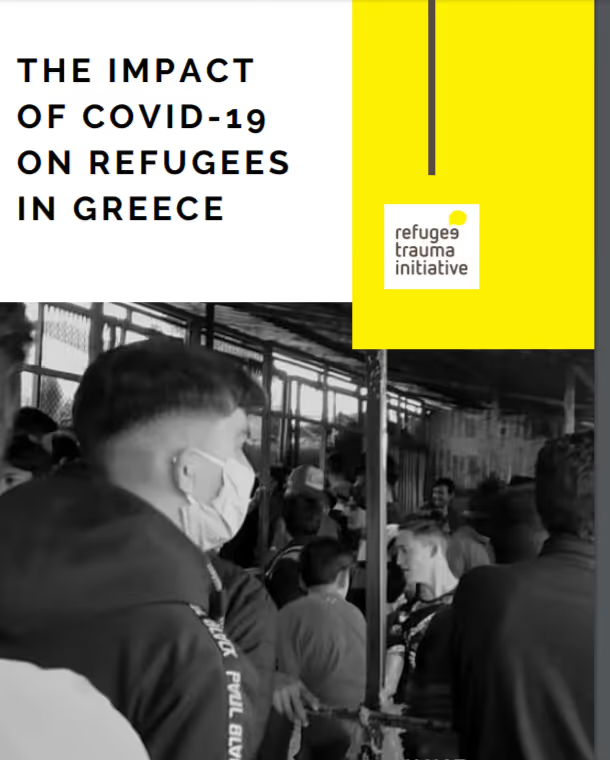
Impact of COVID-19 on refugees in Greece
Everyday experiences are being lost behind the statistics about the COVID-19 pandemic. This is especially true for those already marginalised, such as displaced men, women, and children. At Refugee Trauma Initiative (RTI), we spent time listening to the communities we work with to hear what life has been like during the COVID-19 pandemic and related restrictive measures.
This report sheds a light on the impact of COVID-19 on displaced people living in Greece - particularly the additional strains on their mental health and overall wellbeing. It features stories and reflections from refugees and NGO workers, and includes recommendations for relevant authorities, donors, and NGOs. We look forward to collaborating to help realise these recommendations.
Published in:
2020
Organization(s):
Refugee Trauma Initiative
Language:
Contact:
Evelyn Wilcox, evelyn@refugeetrauma.org