OUTPLAY is building a toolkit for teachers of children aged three to ten. It helps them teach science outdoors, and helps children understand their feelings while they are out there. In July, a group of educators and researchers from five countries came together in Slovenia. They will train teachers in their own countries. First they had to understand the toolkit themselves.
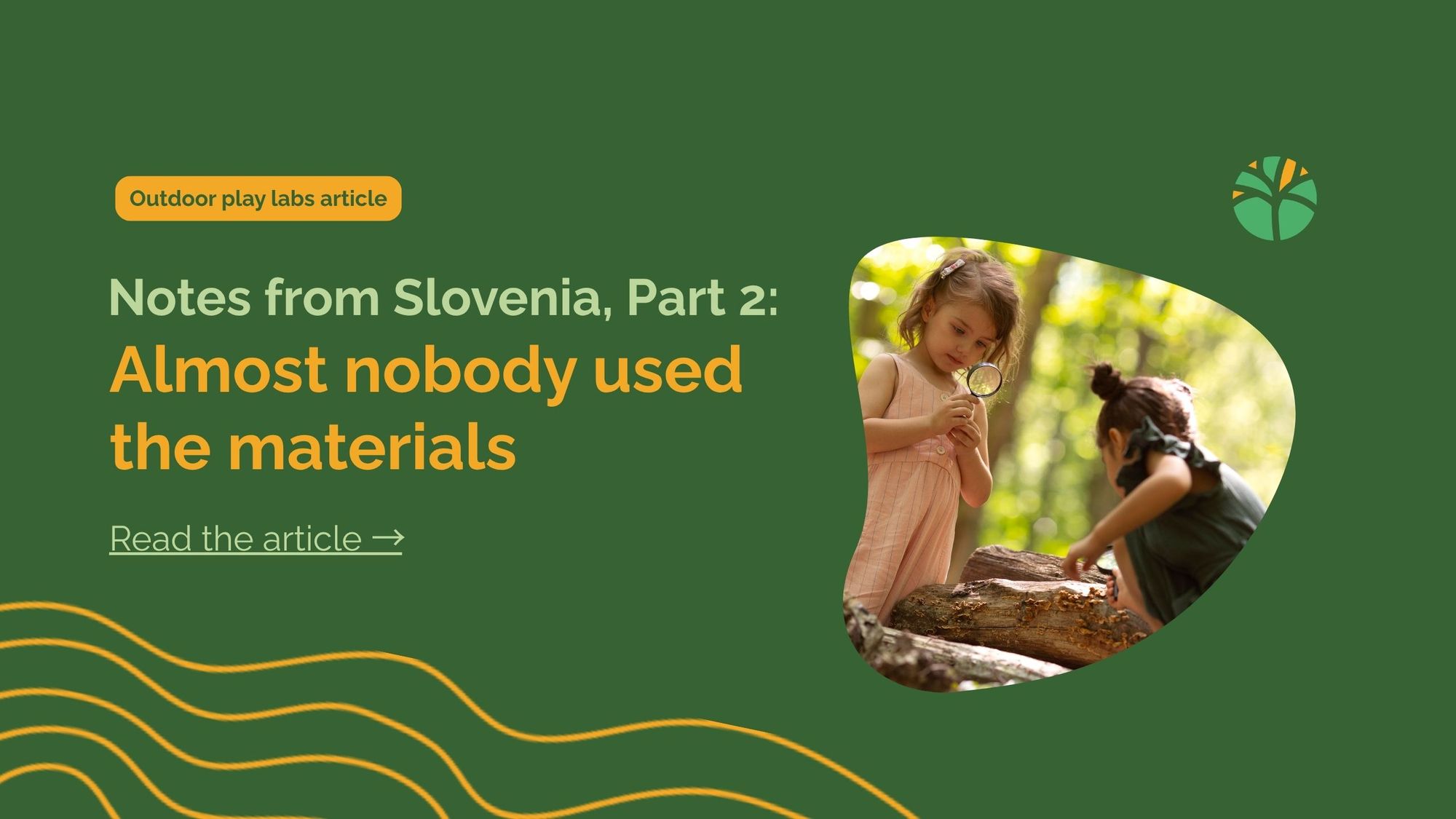
During the training, for one of the first toolkit activities, materials were laid out ready for the group. But most of them were never touched. People used what was already around them instead, what they found on the ground, or what the weather was doing that morning. Each group ended up somewhere different, working with something nobody had planned.
Afterwards, participants said they had not expected this. They were surprised by how much creativity came out of such a simple activity, and by how differently each pair reacted to what they found.
How the activities help participants respond to what is available in their environment
The surprise is understandable, but not accidental. The toolkit is built around open-ended activities, which offer young children a starting point rather than a finished plan. There is no single correct outcome, so the child has to make decisions, test ideas and change direction. It also supports educators in feeling secure with the unexpected as they prepare for and support children through outdoor play.
People who study young children's play have found the same pattern for years. When materials have one obvious use, children use them once and move on. When materials can become many things, children stay longer and invent more. A stick is a lever, a bridge, a measuring tool and a fishing rod, whereas a plastic toy that makes one noise is a plastic toy that makes one noise.
The main materials of outdoor science are already outside: Water, wind, soil, shadow, sticks, and stones. They behave differently every day, and every school already has free access to them.
One small activity, two kinds of learning
Something else surprised the group: a very simple activity did two things at once. There was real discovery, in small steps, such as noticing, guessing what would happen, trying it, being wrong, trying again. The feeling of calm was another important observation: participants described the activity slowing them down and settling them.
This is the heart of what OUTPLAY is testing. Science and emotional learning are usually treated as separate subjects, taught at different times. Both occur in the same moment when young children are outdoors with open materials available to them. A child carefully watching water move is also a child whose breathing has slowed.
What each country brought in their bag
Later in the week the group held a show and tell. Every country had been asked to bring inexpensive materials a teacher could use in their activities. The team members brought natural materials and ordinary household objects. Nothing on those tables was expensive and that was the point. The trainers wanted things they could hold up in front of a group of teachers and say: this is what you need, and you already have it.
There is an assumption in education that quality costs money, but outdoor learning is one of the few areas where that assumption breaks down. A preschool in a village with a small budget and a patch of grass has almost everything it needs. So does a kindergarten with a concrete yard, a bucket and a rainy day.
This matters for the children OUTPLAY was set up to reach: in rural areas, in low-income communities, and in settings that get overlooked when new programmes are handed out. A toolkit that requires a shopping list would exclude them, but a toolkit that requires a stick does not.
What the practitioners changed
A toolkit is written in an office but is tested outside, in the wind, by people who will have to use it on a Monday morning with real children. That is why this week mattered.
The toolkit did not begin in Slovenia. It began with research: on how young children think like scientists, on play that includes some risk, and on how children learn to understand feelings. Slovenia was the first time that work met a room of practitioners. Next come the pilots in the partner countries, where the toolkit will be used with children and evidence will be collected.
Some things worked exactly as intended. The activities guide the adults rather than instruct them, and participants saw how much difference this makes. When the adult steps back and offers a question instead of an answer, the child takes over. The group used three words for what they saw: confidence, curiosity and wonder. They also noticed how small a discovery can be. A tiny experiment, a guess that turned out wrong, a surprise that lasted four seconds. It does not have to look impressive to be real.
The week also tested something built into the design: the double-sided activity card. One side gives the overall picture of the activity while the other offers fuller prompts and support for anyone who wants them. Two teachers with very different levels of experience can pick up the same card and use it differently.
That matters more than it might seem since each trainer will teach other teachers, who will teach others again. Those groups will not have equal confidence, experience, or freedom in their own settings. The materials have to work across all those circumstances, and the week gave the team a clear view of how they do.
What happens next
The pilots begin in the partner countries where teachers will use the toolkit with children, and what happens will be recorded. That is where the evidence comes from: not from a claim that outdoor learning works, but from records of what worked, where, with whom, and what needed changing again. The toolkit will then be published as a free, open resource, along with recommendations for the people who make decisions about early education.
To learn more about OUTPLAY and access the helpful resources and activities, visit: https://issa.nl/outplay/home.
OUTPLAY is an Erasmus+ project co-funded by the European Union. It is led by Škola dokorán – Wide Open School, n.o. (Slovakia), with ICDI (the Netherlands), Fundacja Pro-Fil (Poland), Pučko otvoreno učilište Korak po korak (Croatia), Pedagoški inštitut (Slovenia) and the International Step by Step Association (the Netherlands).