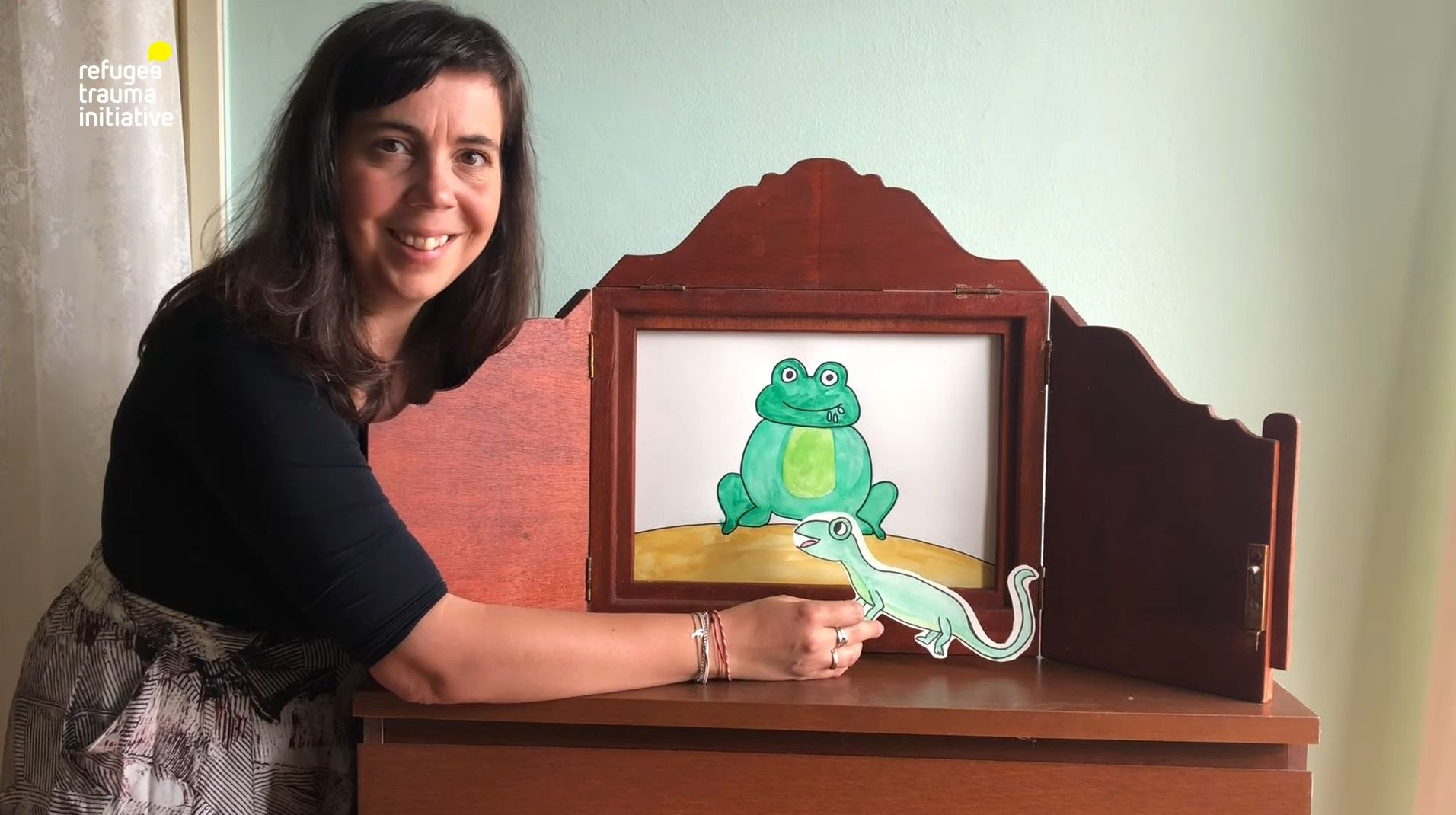
In March 2020, when the COVID-19 pandemic led to a strict lockdown in Greece, playful and in-person interactions suddenly came to a halt at the Baytna program - an early childhood program developed by Refugee Trauma Initiative (RTI) for refugee children and their caregivers. To continue to support vulnerable families emotionally and socially, RTI and its network of partners created a range of multimedia and psychosocial resources, available online in several languages, for Baytna families and beyond.
Children growing up in conflict zones, experiencing displacement, or amid multiple deprivations are at risk of trauma and toxic stress which can interrupt healthy development. In such settings children are less likely to receive the protection, safety, and nurturing care and stimulation they need to meet their developmental milestones.
In Greece, there are 120,000 displaced individuals, including children and their families, many of whom are living with the effects of trauma alongside on-going stress, uncertainty, and adversity. For the past four years, Refugee Trauma Initiative (RTI) has been delivering Baytna - a trauma and identity-informed early childhood development program specially designed for refugee children and their caregivers living in Greece, with a focus on psychosocial support. Baytna program is funded by Help Refugees and Open Society Foundations.
In designing Baytna (which means ‘home’ in Arabic), we followed what the science tells about the power of creative expression, play, and relationships for healthy development and healing from adversity. It relies on in-person interactions between facilitators, children, caregivers and trauma- and identity-informed learning environments that are created.
Since mid-2019, we scaled up Baytna through a network of local organisations who we train and provide ongoing mentoring as part of a year-long capacity building program. As of early 2020, Baytna was running at five sites across Greece: two in Athens, and three in North Greece - Thessaloniki, Polikastro and Katerini.
Supporting displaced families amidst COVID-19
In March 2020, when the COVID-19 pandemic spread worldwide and Greek authorities began a strict lockdown, thousands of displaced families were suddenly forced to stay at their residence, and the usual nurturing interactions at Baytna became impossible as centres had to close.
It was important to continue supporting the families who attended Baytna so that they felt emotionally and socially supported - receiving care, feeling connected with a community, and having Baytna-inspired activities to do. In addition, consultations with people from displaced communities revealed the need for remote and innovative psychosocial support.
New era of programming
As Greece began lifting its lockdown from May 2020, the Baytna network has started to launch in-person programming again. The online resources will continue to be shared and created digitally. RTI colleagues share that it has been a joy to allow children who had already been attending Baytna to reconnect with their facilitators, if only by video, and to continue programming at a distance. It is even a greater joy to welcome children who live in other parts of Greece or in the other countries to access Baytna activities for the first time – and website statistics demonstrate the wide reach of the resources so far.
The Baytna network now has a growing bank of psychosocial resources and multimedia which are already being brought into their sessions. These can be used for any future lockdown situations, and to support RTI when training new Baytna partners. The recent collaborations have also strengthened the network and the connections between Baytna partners, fostering collaboration, sharing of ideas and development of language resources.
The COVID-19 crisis has reminded us of the power of a network, with shared values and vision, in responding with agility to changing needs of the communities we work with. Together, we can help to ensure that displaced children across Greece receive nurturing and quality care, and flourishing futures, amidst challenging and changing circumstances.
Written by Evelyn Wilcox, Head of Knowledge Management, Refugee Trauma Initiative, in collaboration with RTI team
Pictures:
1. Vasileia, a Storyteller and Baytna Facilitator at Athen's Comic Library, as she created a Baytna video
2. Activity sets sent to families during the COVID-19 lockdown.