OUTPLAY is building a toolkit that helps teachers take science outdoors with children aged three to ten, and helps children understand their feelings while they are out there. It is an Erasmus+ project working in Croatia, Poland, Slovakia and Slovenia.
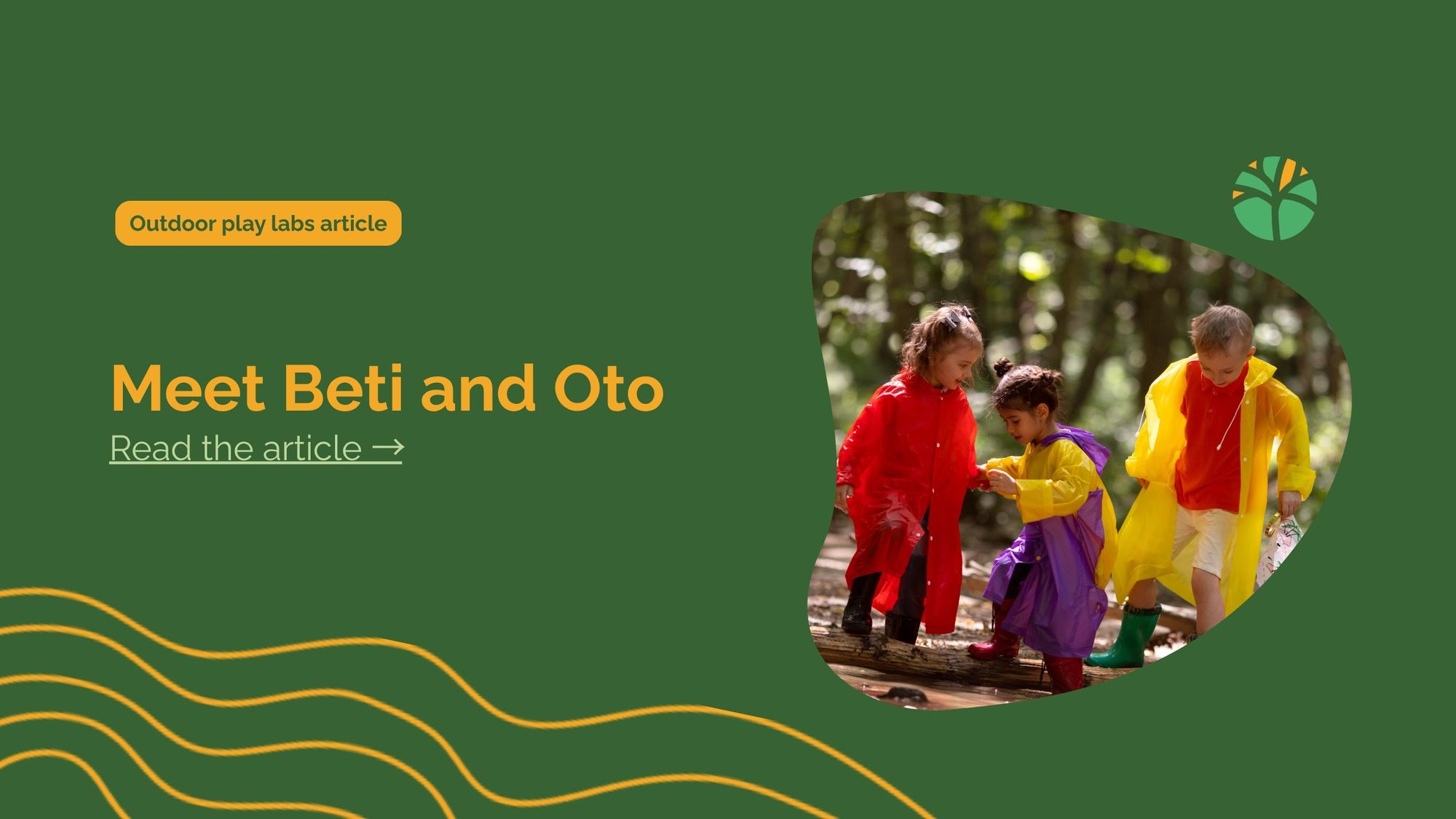
Two characters appear on every activity card in the OUTPLAY toolkit. Beti is a bee. Oto is a snail. You can already guess how they behave.
Beti wants to try something. Her question is always about action. What do you think will happen if we add more water? Try it three different ways, and see which one works best. Oto wants to stop for a moment. His question is always about noticing. Before you start, what do you already see? How did your group work together today, and what helped?
They are not decoration. They are the two halves of what OUTPLAY is trying to teach, standing side by side on the same card. The mascots' genders and personalities are deliberate, too: they're meant to unsettle the assumptions young children, and their teachers, carry about how girls and boys behave. Beti is a "she," bold and action-oriented. Oto is a "he," careful and observant.
Two things that are usually taught separately
Science and emotional learning are often treated as separate areas. Science is often the lesson where children measure, test and find answers. Feelings are viewed as what a teacher deals with afterwards, when someone is upset, or during a special lesson about friendship on a Thursday.
OUTPLAY is built on the idea that this separation is artificial, and that outdoors it disappears completely. Think about a child building a small dam in a stream of water. She is testing an idea, and changing it when the water goes the wrong way. That is science. She is also waiting for her turn, becoming frustrated, deciding not to give up, and asking a friend for help. That is emotional learning. Nobody switched from one to the other, but rather both happened within the same ten-minute span.
Beti and Oto help make this important distinction more visible for the adult. When teachers read a card, they see both prompts sitting there together, and both are equally important.
Fast and slow are both correct
There is something else in the choice of a bee and a snail. Fast answers often get more visible praise in a classroom; careful, slow noticing often gets less. But a scientist who never slows down to observe can miss what matters; one who never acts doesn't find out what happens when something changes. The toolkit puts the two side by side and treats them as equal, which quietly tells a child that her way of thinking is a real way of thinking.
That is useful for adults too, as teachers who are naturally careful and quiet are not worse outdoor educators than those who are bold and quick. They are Otos and the toolkit needs them.
Who children imagine doing science
There is one more reason these two characters matter: to address prevalent gender gaps in science, which can begin as early as the younger years. They begin through many small, unintended instances that nonetheless make a difference. Such as which pictures appear in books, who is shown holding the equipment, which child is asked to carry something heavy, and which is asked to be careful.
OUTPLAY addresses this deliberately by ensuring that neither Beti nor Oto is the singular clever character, the leader, nor the assistant. On every card, they help show to every child in the room that there is more than one way of being a scientist, all of them necessary. It is a small design decision, and young children notice those small but important design decisions.
To learn more about OUTPLAY and access the helpful resources and activities, visit: https://issa.nl/outplay/home.
OUTPLAY is an Erasmus+ project co-funded by the European Union. It is led by Škola dokorán – Wide Open School, n.o. (Slovakia), with ICDI (the Netherlands), Fundacja Pro-Fil (Poland), Pučko otvoreno učilište Korak po korak (Croatia), Pedagoški inštitut (Slovenia) and the International Step by Step Association (the Netherlands).